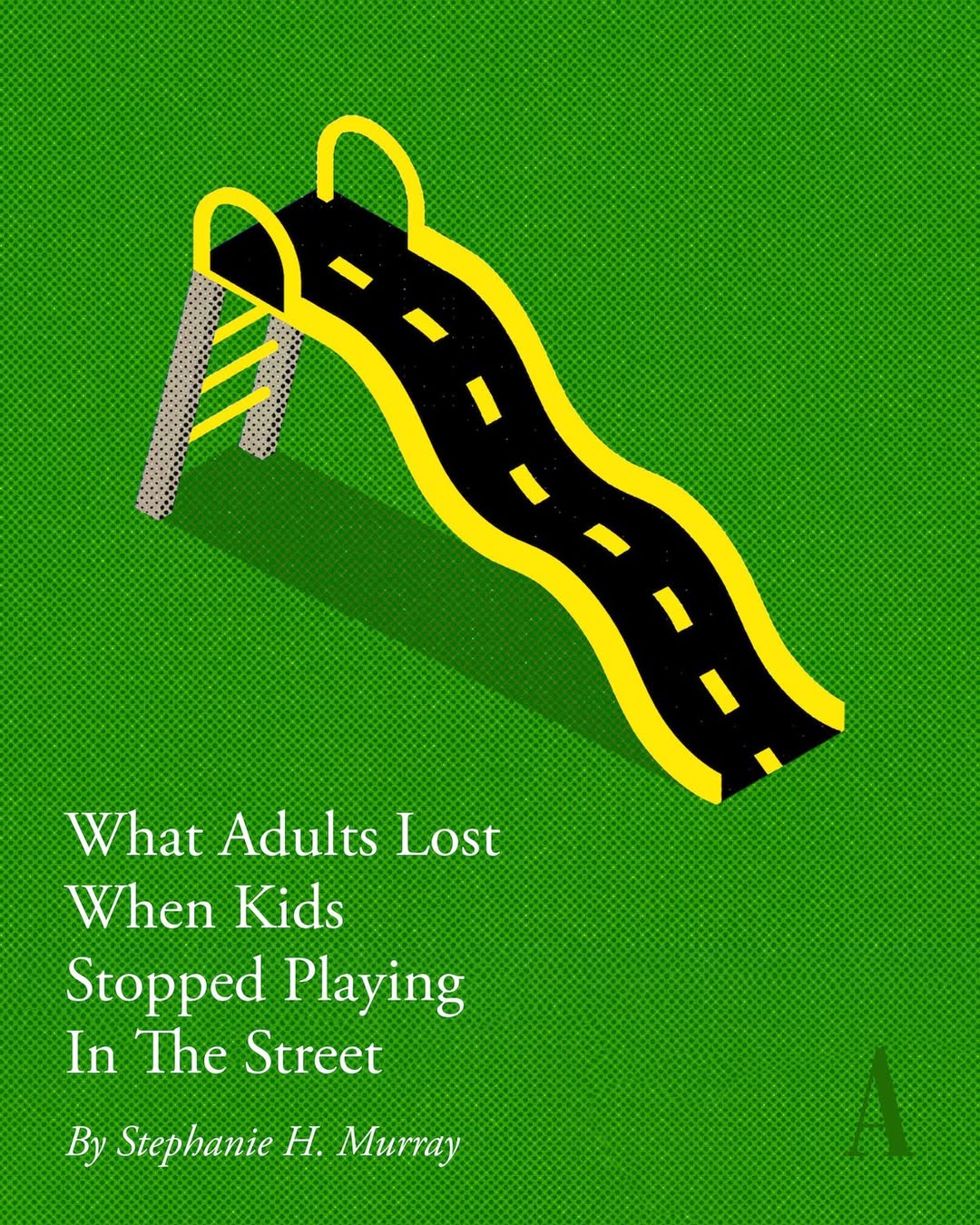
A world built for cars has made life much harder for grown-ups, Stephanie H. Murray wrote in 2024. https://theatln.tc/XVjVdlji
In 2009, two mothers in Bristol, England, experimented with closing part of a neighborhood road to traffic for two hours after school. “The experiment also produced some unexpected results,” Murray writes. “As children poured into the street, some ran into classmates, only just then realizing that they were neighbors … That session, and the many more it prompted, also became the means by which adult residents got to know one another.” As the experiment has expanded, “neighborhoods across the country have discovered that allowing kids to play out in the open has helped residents reclaim something they didn’t know they were missing: the ability to connect with the people living closest to them.”
Roads were once areas of community and play. “Only when cars hit the streets in larger numbers did things begin to change,” Murray writes, as “deliberate efforts within the auto industry shifted the blame for traffic deaths to children and their parents.” Streets became a place for children to cross only when cars were absent, and speed limits subsequently rose.
Play streets can now be found sporadically in urban centers. Play streets help bind communities, because adults must work together to enact the logistics of shutting the roads down. But it could also have something to do with the way children’s play alters the feel of the street, giving adults permission to engage in the sort of socializing “we’ve otherwise policed out,” one expert told Murray; kids function, he pointed out, as a sort of “connective tissue for adults.”
“Children’s tendency to violate social boundaries—to stare a little too long, ask someone an overly forward question, or wander into someone else’s yard—can nudge adults to reach across those boundaries too,” Murray continues at the link in our bio. “It probably isn’t a coincidence that playgrounds are one of the few places in America where striking up a conversation with a stranger is considered socially acceptable … By siloing play there, we may have inadvertently undercut children’s capacity to bind us to one another.”
—
:Ben Kothe / The Atlantic. Source: Giuseppe Ramos / Getty
Discover more from I didn't have my glasses on....
Subscribe to get the latest posts sent to your email.
 I didn't have my glasses on....
oh yes, we ‘sort of’ have a playstreet where we live; it’s a dead-end tiny bit of road, but with access to a large underground parking and rental and visitor parking. BUT we all know to drive super slow, because there are kids playing everywhere, but also cats carelessly crossing and toys, trottinets, strollers, and clothes might lie here or there…. In Zurich we have (had?) bits of playground-streets, closed to traffic – and it’s a wonderful thing. It’s very dear to us because there are far too few places where kids can be kids and many an opportunity to have a chat with an unknown neighbour ensues.
LikeLiked by 2 people
yes, those spaces are so important and precious
LikeLiked by 1 person
Children NEED to play outside and we NEED to talk to our neighbors!
LikeLiked by 1 person
it’s good for all
LikeLike
Wow, I never thought of it that way. I have been lamenting the absence of kids playing in the streets, and bemoaning the fact that we’re making a socially awkward generation. Hadn’t realized it’s also making socially awkward adults.
This is a very good share, Beth.
LikeLiked by 1 person
it all fits together really –
LikeLike
Play streets
For little feet
And older beaks
To meet and greet
And enjoy the beat
Of the street … Ivor
LikeLiked by 1 person
love the poem!
LikeLiked by 1 person
I love this idea. And the kids would be away from their screens as well
LikeLiked by 1 person
a win for all –
LikeLiked by 1 person
Absolutely. 👍🏼
LikeLiked by 1 person
What a great idea!
LikeLiked by 1 person
it makes total sense
LikeLiked by 1 person
Very much so .
LikeLiked by 1 person
love this
LikeLiked by 1 person
a simple experiment with very positive results
LikeLiked by 1 person
Simple ideas with great results.
LikeLiked by 1 person
so right!
LikeLike
We lived on a busy county road in Ohio’s Amish country when our daughter and son were growing up. When they became annoying, I used to say, “Go out in the street and play.” Fortunately, they understood sarcasm.
LikeLiked by 1 person
good thing!)
LikeLiked by 1 person
Until I was sixteen, we had woods and fields. After sixteen, I had waves. The streets had little traffic, so they seemed always open.
LikeLiked by 1 person
Wonderful!
LikeLiked by 1 person
I have always lived in suburban areas with front yards. No need to play in the street. We did occasionally have block parties where, with city permission, we could block off the street for a day and gather there for a party.
LikeLiked by 1 person
oh, how fun!
LikeLike
I recently reunited with a childhood friend and neighbour – after 33 years of living down the hall from each other in the same apartment building am going to grades 5 and 6 together. This was one of the things we spoke about – how different our childhoods were and how lucky we were that we grew up in a time when kids plays outside all day, unattended, and came home for dinner and then out again until dark. Streets were for cops and robbers games and street hockey and chase. No screens. No crime. No harm. No worry or paranoia. A different time. How I wish T could grow up in a similar time.
LikeLiked by 1 person
how lucky that you had this reunion, as well as played like that as children, it was magical and full of imagination and fun, wasn’t it? yes, I’m sure he would love it too
LikeLiked by 1 person
This is such an interesting read. Growing up on a farm, my playmates were my siblings and we had free roam of the land from grove of trees to our massive yard. Only at school or when we visited extended family did we have playmates. So much has changed. It’s a different time. But, yes, we have lost much due to, I think, overly-scheduled lives filled with activities. Kids need time to free-play and that seems to be lacking. Just my opinion.
LikeLiked by 1 person
I so agree with you and it made me sad as a teacher to see that happen over the years. I always tried to encourage parents to have unscheduled time for the children. we put up ‘let the children play’ in our room every year and talked about it at our opening meetings with families, how important it is in a child’s development for so many reasons
LikeLike
Hi Beth, I’d never considered this before but it makes perfect sense
LikeLiked by 1 person
it really was an interesting look at what is lost
LikeLike
Yes, its sad.
LikeLiked by 1 person
Wow…what a powerful closing sentence about the siloing…undercutting children’s capacity to build connections…adults, too. Thank you, Beth. 💝
LikeLiked by 1 person
it really was eye opening –
LikeLiked by 1 person
💝💝💝
LikeLiked by 1 person
Great idea! It makes sense and all benefits from it!
Blessings!
LikeLiked by 1 person
it really does, it’s so good for a community and the connections happen organically
LikeLiked by 1 person
what a wonderful concept: a thing that Councils here could experiment with: give streets back to the people; roads for cars —
LikeLiked by 1 person
yes, it’s such an easy fix and so beneficial to all ages
LikeLiked by 1 person
I grew up in a town of 15,000 people in the Midwest. I wouldn’t call it playing on the streets, but we used to organize our own ballgames in a nearby vacant lot, go cardboard sliding in the summer, and sledding on the same hill in the winter. I had the best childhood. We played outdoor games in the evening with all of the kids in the neighborhood.
LikeLiked by 1 person
yes, and it’s just so fun – whoever was outside played –
LikeLiked by 1 person
I remember having cocktail hour in our driveways with the neighbors during COVID, the kids ran around, hardly any cars in the streets, and we chatted to each other from our beach chairs. It was so fun. Neighbors we hardly ever talked to came out. Such a powerful conclusion, “We may have inadvertently undercut children’s capacity to bind us to one another,” Hugs, C
LikeLiked by 1 person
I love that and it happened organically-
LikeLiked by 1 person
everything old is new again?
LikeLiked by 1 person
yes!
LikeLiked by 1 person
I love this experiment and the results.
LikeLiked by 1 person
it really makes so much sense
LikeLiked by 1 person
so interesting the idea of striking up a conversation in a playground – so true – here in Australia there is a move towards “old fashioned” playgrounds that are more natural and more risky – it’s like a revelation that kids should be adventurous! :)
LikeLiked by 2 people
yes, here too, I was a pre-k teacher and we were always going more in that direction and some people always worried about it
LikeLiked by 1 person
Luckily we have some great bushland near where we live, so our kids got to go wild regardless of park designs!!
LikeLiked by 1 person
wonderful
LikeLiked by 1 person
How interesting! We have quite a few streets in our neighborhood that closed to traffic in the pandemic and have stayed that way. A good social experiment!
LikeLiked by 2 people
wonderful!
LikeLike
So interesting. It makes perfect sense. We used to play baseball, using the sewer covers for bases. But other than that, we didn’t play in the street. We had alleys and parks. But I can certainly see how this might help people get together.
LikeLiked by 1 person
What fun we had as kids, kicking balls down the street, playing hopscotch, climbing trees – they have no idea what they are missing out on!
LikeLiked by 1 person
So right!
LikeLike
Great idea!
LikeLiked by 1 person
it makes so much sense –
LikeLike
We loved to play in the street when we were children. I would not have liked to miss this wonderful time.
I just saw that you have so much snow, hope you keep warm.xx
LikeLiked by 1 person
yes, in the north of our state!
LikeLiked by 1 person
There are so many things that we did as kids that kids these days no longer do. I can remember getting dressed, having breakfast and then being told by my mother to get out of the house. We weren’t allowed to play inside. We would go off with no supervision and I can guarantee my mother had no idea where we were.
LikeLiked by 1 person
yes, same, and somehow we lived to tell )
LikeLike
This is so needed!!
LikeLiked by 1 person
Absolutely
LikeLiked by 1 person
😀
LikeLike
That experiment by the two moms was so beautiful.
Reading your post, I realized all of it is soo true.
I remember growing up, the highlight of the day was the play time in the neighborhood after school, just before dinner.
I wish we could bring those days alive for our kids in this season.
They actually do stare and now I know why.
Thank you always Beth
LikeLiked by 1 person
yes, it all makes perfect sense and is good for everyone, the connections –
LikeLiked by 1 person
I remember when I was a kid, we’d all gather in the street, traffic was minimal. X
LikeLike