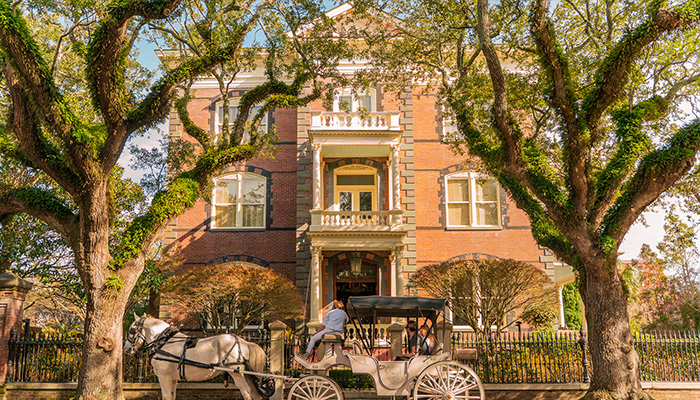
here is the biggest house in Charleston, South Carolina, USA
(in contrast to yesterday’s tiniest house)
—
The Williams Mansion is the largest private residence in all of Charleston.
Built in 1876 by George W. Williams, the mansion was his contribution to the reemergence of Charleston after the civil war. It took nearly five years to build, employing hundreds of local artisans and craftsmen and is more than 24,000 sq ft containing 35 grand rooms including the grand ballroom and the music room which boasts a 45 ft covered glass skylight. The home also holds 23 period fireplaces, numerous ornate chandeliers and beautiful plaster and wood molding.
It is known as the “Grande Dame” of Charleston’s great homes and was once dubbed “the greatest post civil war home on the eastern seaboard.” After the death of Williams in 1903 the house began to deteriorate and was eventually condemned in 1972. The mansion was eventually rescued by a Charleston native who spent 25 years and nearly five million dollars restoring it to its original grandeur.
Discover more from I didn't have my glasses on....
Subscribe to get the latest posts sent to your email.
 I didn't have my glasses on....
Oh wow it’s stunning but that is a great quote. I’m happy with a small cosy home.
LikeLiked by 1 person
I could not agree more, I wanted to show the contrast from the tiniest home that I saw there. I am all about living in small cozy homes, I would never be comfortable in a big house and this one, is super huge
LikeLiked by 1 person
That’s a really good contrast Beth, one extreme to the other.
LikeLiked by 1 person
Very palatial indeed, Beth
LikeLiked by 1 person
that is the word for it, Ivor. I prefer to life in my little home, though
LikeLiked by 1 person
Yes, far too big for me and Frankie 🐶😍
LikeLiked by 1 person
What a marvelous building
LikeLiked by 1 person
it’s beautiful to see, but love to live in a small cozy home
LikeLiked by 1 person
Me too, we have a medium sized house but now I find it too big.
LikeLiked by 1 person
I’m glad this beautiful house was rescued.
LikeLiked by 1 person
yes, it’s good that it was
LikeLiked by 1 person
I’ve always wanted a big old historic house. This is gorgeous!
LikeLiked by 1 person
it really is, but don’t think I could ever live in one -)
LikeLiked by 1 person
It’s impressive, but I also liked the style of the old ‘Plantation houses’ built before the Civil War . (Great quote too!)
Best wishes, Pete.
LikeLiked by 1 person
yes, those are very pretty
LikeLiked by 1 person
Nice!
LikeLiked by 1 person
big and beautiful, but not the kind of house I’d like to live in –
LikeLiked by 1 person
Too much work to look after
LikeLiked by 1 person
Wow !
What a beautiful building.
LikeLiked by 1 person
it is, but not one I could live in. I’m more into cozy, little houses –
LikeLiked by 1 person
Yeah, me too !
LikeLiked by 1 person
Agatha got it right.
LikeLiked by 1 person
she did, not my kind of house at all, small cozy houses are my kind of houses
LikeLiked by 1 person
We are quite happy in 1497 sq. feet; one big room and a hallway with bedrooms.
LikeLiked by 1 person
yes, I so get that –
LikeLiked by 1 person
It certainly has street appeal.
LikeLiked by 1 person
that is does, but not one I could live in, I’m all in for small, cozy houses
LikeLiked by 1 person
The drawback of “big” is big upkeep.
LikeLiked by 1 person
and not cozy and I would be lost all of the time
LikeLiked by 1 person
What a shame it would have been to lose this house.
LikeLiked by 1 person
ooh, yes –
LikeLike
That is one mighty big house, which I would like to tour. But live in? No, thank you.
LikeLiked by 1 person
I could not agree more. the history is interesting, but so far from anything I would live in. I am all for cozy, small homes feel like home. this reminds me more of a museum.
LikeLike
I love old houses, and such places that tell amazing stories. Thank you, Beth! ❤️
LikeLiked by 1 person
I’m sure there are many stories from this one, but I love little cozy homes
LikeLike
33 grand rooms too many for me!
LikeLiked by 1 person
way to big for me, too! I’m all about small, cozy homes –
LikeLike
Very nice and old ♥
LikeLiked by 1 person
it is, but not my style of something I could live in, too big!
LikeLiked by 1 person
What a beauty! How lucky it was restored. And a great quote, to boot.
LikeLiked by 1 person
It is, and I could never live there, I love living in cozy little houses )
LikeLiked by 1 person
Oh same. Plus, I hate house-keeping! ;-)
LikeLiked by 1 person
yes!
LikeLiked by 1 person
Ha – love the contrast. So good, Beth!
LikeLiked by 1 person
thanks, wynne. I fall more to the tiny house side –
LikeLike
Spending $5 million on a restoration job obviously shows how much that person loves the property. I guess if I were filthy stinkin’ rich, I might do the same. Alas, I’m at most two of those three things on any given day, and neither of them rhymes with itch.
LikeLiked by 2 people
not going to ask which )
LikeLiked by 1 person
This house is not only a gem of the past, but it is also a contemporary witness. Thank God, it was rescued. The quote at the end makes you think about how the people who lived there felt!
LikeLiked by 2 people
right! and I’m more of a small house person
LikeLiked by 1 person
Hehe, so am I 😁
LikeLiked by 1 person
smallest and then biggest. It looks like an impressive and beautiful old house. 35 grand rooms is certainly impressive.
LikeLiked by 1 person
I’m sure it must be grand inside, but my kind of house/home is small and cozy
LikeLiked by 1 person
Same here. I don’t want to live in big houses but they are nice to look at.
LikeLiked by 1 person
I really want to know what the inside looks like for this one too! The 23 fireplaces sound amazing and we just don’t build homes like this one anymore!
LikeLiked by 1 person
right, this was just after the civil war in the south so people were going big – good to have a look around I’m sure.
LikeLiked by 1 person
From the smallest to the biggest.
LikeLiked by 1 person
right – two extremes
LikeLike
That is a contrast from the tiny house to this one, but man is this a BIG house. Add me to the list who are curious what that inside space looks like!
LikeLiked by 1 person
it would be cool to walk around in there –
LikeLiked by 1 person
Funny what pops into one’s head. The first thing I thought about was I’m sure glad I don’t have the job of cleaning that house.
LikeLiked by 1 person
right!!!
LikeLiked by 1 person
On the other hand, invite over a crowd to this great-looking mansion, Beth!
LikeLiked by 1 person
as many as you want! I’m still a small, cozy house person though –
LikeLike
Big and beautiful – but I still prefer the tiny house!
LikeLiked by 2 people
same!
LikeLike
I love old houses like this – as long as they’re not haunted.
LikeLiked by 1 person
I have a feeling….
LikeLike
George must have had a pretty big family or just a show off! :) Although a beautiful city, I felt a kind of sadness while visiting there one time…that many of those huge beautiful homes were built on the back of slaves from the money made from owning them.
We did read that some of the “plantation” homes are no longer a venue for joyful events such as weddings, etc. as their history was far from joyful for generations of the Gullah people that were enslaved in them. Chris
LikeLiked by 1 person
chris, exactly how it felt, when learning the history. it’s an odd feeling in the city. there are big and small and in between things. the old, the new, and yet, the history, the stories, will never fade, they will always be there. I so agree
LikeLike
Thank goodness a Charleston native saved the mansion.
LikeLiked by 1 person