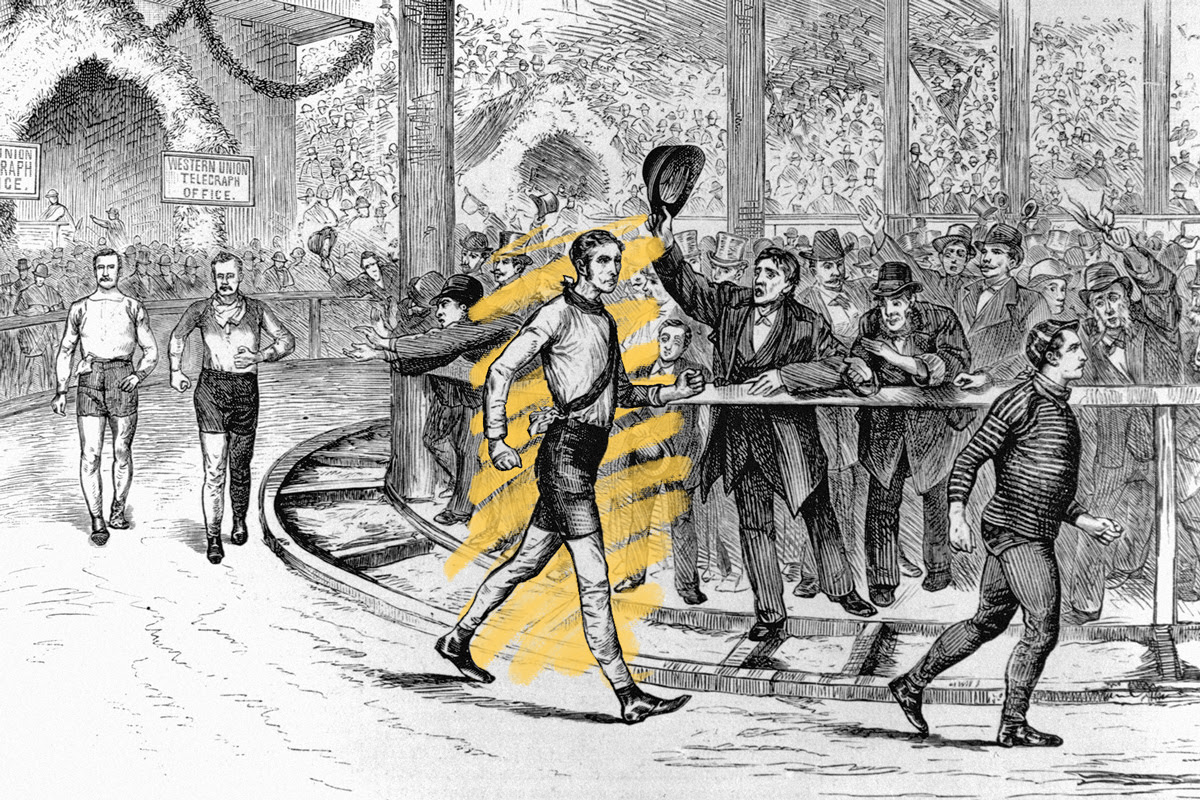
Walking was a competitive sport in the 19th Century
On March 10, 1879, the arena at Gilmore’s Garden in New York City (later, Madison Square Garden) was absolutely packed with screaming fans of America’s latest sports craze: pedestrianism. That’s right, competitive walking. At the venue, fans outside tried to shove themselves in, breaking windows and scaling the roof. It was no less chaotic inside, where ticketholders scrambled on top of tables, chairs, and each other’s shoulders to get a better view. That day marked the start of the Astley Belt, essentially the Super Bowl of walking. Contestants had to circle the 1/8-mile track for six days straight and reach a distance of at least 450 miles, and whoever traveled farthest was declared the winner. Athletes were not permitted to leave the track, and instead had tents or cottages where they were allowed to get a little rest or medical attention.
Americans’ fascination with pedestrianism can be traced back to one man, a New York Herald employee named Edward Payson Weston who had a penchant for long-distance walking. Recognizing his gift for endurance, he made a bet with a friend on the 1860 presidential race, in which the loser had to walk all the way from Boston to Washington, D.C., for the inauguration. Because Weston bet against Abraham Lincoln, he found himself on a 10-day trek through ice and snow that made him a media darling. He started organizing endurance walks against other people, which grew into pedestrianism.
The sport reached the peak of its popularity in the 1870s and 1880s, at which time it was far more than a novelty. Pedestrianism spawned America’s first celebrity athletes, complete with trading cards and brand endorsement deals. Weston was the first; he was so famous that scientists published studies on his urine. Many later superstars were immigrants and people of color: One of the last great pedestrian celebrities was Frank Hart, a Haitian immigrant with a record-breaking career that included a 565-mile, six-day walk. Plenty of women participated in the sport, too — as the March 1879 Astley Cup marched on in midtown Manhattan, five women were competing in their own six-day walk up in Harlem.
at first
I thought I might be a contender,
as an expert level pedestrian
but then I read on
saw how far and how fast they went
this was not to be
I will continue on my quest
to find my sport.
(so far I’m leaning in the direction of ‘ yard sports’
in the realm of badminton and croquet, but not jarts)
—
‘i’m in competition with myself and i’m losing.’
-Roger Waters, Pink Floyd, bassist and co-founder
—
source credit history facts.com
Discover more from I didn't have my glasses on....
Subscribe to get the latest posts sent to your email.
 I didn't have my glasses on....
Isn’t it still?
LikeLiked by 1 person
not at that distance –
LikeLiked by 1 person
And they are still doing it. Though the way they ‘walk’ is often debabtable.
‘Race walking is still an Olympic sport, and it includes the 20-kilometre race walk for men and women, and a new marathon race walk mixed relay introduced at the 2024 Paris Olympics.’
Best wishes, Pete.
LikeLiked by 2 people
walking is a relaxing activity for me.
LikeLiked by 1 person
but they no longer go for those epic distances at that speed, it’s either speed or distance
LikeLiked by 1 person
For me, race-walking would take the joy from walking.
LikeLiked by 2 people
absolutely, I walk to relax
LikeLiked by 1 person
heel toe
LikeLiked by 1 person
lots and lots of it
LikeLiked by 1 person
I didn’t know this! Awesome!
LikeLiked by 1 person
interesting history -)
LikeLiked by 1 person
Me and Frankie enjoy our walkies, but we are too old to participate in such an arduous event, Beth … 🐶🌏
LikeLiked by 1 person
never would have worked for me –
LikeLiked by 1 person
Fascinating origin story, but just NO :) I walk to enjoy nature and calm my brain, not die slowly on a track.
LikeLiked by 1 person
I’m not into speed, so wouldn’t work for me –
LikeLiked by 1 person
I’m still in it :-)
LikeLiked by 1 person
there you go!
LikeLiked by 1 person
Love this…I was vaguely aware but you put the pieces together for me Beth. Thank you! Great glimpses of history! 🥰 ❤️🥰
LikeLiked by 1 person
there’s so much fun history out there -)
LikeLiked by 1 person
Thanks for bringing it to us! 🥰❤️🥰
LikeLike
A very interesting trivia, Beth! It would be nice if they brought this back as a way to also increase social connection and to combat health related issues. It could do so well!
LikeLiked by 1 person
you’re so right! a pretty harmless social interaction –
LikeLiked by 1 person
I love to walk at a comfortable pace.
LikeLiked by 1 person
me too, otherwise I don’t enjoy it
LikeLiked by 1 person
I miss being able to walk mountain trails. :(
LikeLiked by 1 person
I’m sure you do, that would be wonderful
LikeLike
Fascinating – I’d never heard of pedestrianism! Not jarts — that’s very wise, Beth!
LikeLiked by 1 person
why I’m still here, probably
LikeLiked by 1 person
Right! :)
LikeLiked by 1 person
How remarkable
LikeLiked by 1 person
yes!
LikeLiked by 1 person
👌🏼
LikeLike
Whilst I am in awe of them, this is not something I would ever want to undertake. My walking, while brisk has stops for photo-taking along the way ;-)
LikeLiked by 1 person
same!
LikeLiked by 1 person
I thought I understood speed walking as a workout activity — somehow I think it must pale in comparison to what this event was. No thanks. Walking is one thing, even power walking is doable, but basically sprinting while in walking format makes my eyeballs itch. 🤣
LikeLiked by 1 person
and the distance was insane!
LikeLike
I always tell people that my 2 sports are bridge and natural childbirth, and that I’m retired from one of them.
LikeLiked by 1 person
well done!
LikeLike
This is most interesting. Love Pink Floyd music too.
LikeLiked by 1 person
same –
LikeLiked by 1 person
❤️
LikeLike
I’m thinking I’ve seen power (competitive) walking somewhere. I can see the stride in my head – a lot of heel/toe and elbow action.
LikeLiked by 1 person
it is a thing, but not at these wild distances –
LikeLike
One of my son’s friends did long-distance competitive running for a few years. How far? 100 miles. I don’t know all the rules, but I know there was a time limit to complete the run. His mom said that by the end, some of the runners were delirious. 0% chance I would ever do something like that. I don’t even like running one mile.
LikeLiked by 1 person
I am so with you on this, but I’m amazed by anyone who can do something like this
LikeLiked by 1 person
I had no idea. And you don’t think you’re a contender? Well, yard sports are important. I think I’ll try book buying and reading in a three day marathon. Who knows what will happen. This is such a fun post. Just know that I will never be walking 500 miles, for any reason at all.
LikeLiked by 1 person
you will be a hard one to beat in your category!
LikeLike
The last person was Edward Payson Weston’s walk from New York to Minneapolis in 1913 at age 78. Very impressive. I can walk a few miles!
LikeLiked by 1 person
yes, that’s more my style, and at a normal speed
LikeLiked by 1 person
If there was a ‘who can walk the slowest’ race, I think I’d stand a chance!
LikeLiked by 1 person
I’ll be there with you!
LikeLike
I have never heard of this Beth. I have enough trouble walking period let alone racing.
LikeLiked by 1 person
yes, and for those crazy long.distances
LikeLike
I walk every day,,,,,,, good for the legs………good for the eyes. The otherwise invisible things you can see when you travel on Shank’s Pony!
LikeLiked by 1 person
exactly!
LikeLike
It’s so much fun to discover the quirks of the past.
LikeLike
Who knew? This was fascinating, Beth.
LikeLike
I used to think I could be a good race-walker, Beth. Upon further review, I’m just a pedestrian stroller.
LikeLiked by 1 person
same -)
LikeLike
I recently stumbled on this history of competitive walking when I read Grandma Gatewood’s Walk and it was part of the backstory. It was fascinating to me. I love both running and walking to the point that it annoys people because I cannot sit still.
LikeLiked by 1 person
I love to walk, not run, and not for any long distance, so I would definitely not be a contender. my youngest daughter told me that she now has figured out why her one grandfather frequently used to tell her to walk around the outside of the house a few times when visiting, now that she has her own child with ADD,
LikeLiked by 1 person
It’s interesting to see that a topic that’s often overlooked is finally receiving the attention it deserves. The value of walking and being present in our surroundings made me appreciate the simple act of walking a little more.
LikeLiked by 1 person
yes, I agree
LikeLike