According to Demas, the story starts in London, Ontario, decades ago, in the early ’70s. Demas was a 19-year-old newlywed whose husband worked in real estate and had a good eye for potential. After a discovering a building that had once housed a restaurant, Tony pitched his wife on opening their own restaurant, and together, the two established an eatery called The Villa.
Before then, Demas had zero culinary experience and had never envisioned herself working in a restaurant kitchen. But as she tells it, on The Villa’s opening day, the restaurant’s chef had one too many beers, and Tony asked his wife to step in. “I knew nothing honestly about food,” she explained. “But I did know how to make a grilled cheese, so I thought, ‘OK, our special’s just going to be grilled cheese sandwiches. That’s it.’ That’s the only thing I knew how to (make) … and maybe boil water.”
The sandwiches were a hit, and the restaurant managed to stay afloat. Sometime around 1973, it was there that the couple came to meet future regulars, Audrey and John Kinnear. After a while, the couples became friendly, and — because it was the ’70s — they decided to start making some trades.
“After a while, he started bringing in some of his art and asked my husband if we could trade for their lunches for his art,” Demas explained. “We happened to really love his art. He did some very beautiful watercolors … he did a lot of European kind of stuff, English countrysides and beautiful animals.”
“We never really kept tabs, to say, ‘OK, well, you were in, and you spent $15. Now, you know, you’re gonna give us $15 credit,'” she continued. “There was such a wonderful relationship with the Kinnears.”
Nothing was a tit for tat. They simply offered and took and, eventually, one day, Kinnear came in with a set of paintings that weren’t his own to trade. Demas remembers that Kinnear told the story of the artist he’d met who had limited mobility (Maud Lewis had rheumatoid arthritis) and was of simple means. He set up six artworks from different artists around chairs and against glassware and presented them to Demas and her husband.
“(Kinnear) came in with this very strange-looking art. It was on board, unframed, a very childlike, very primitive art that I’d never seen before,” she explained. “I’m not an art expert, and we weren’t art collectors. We just knew what we liked.”
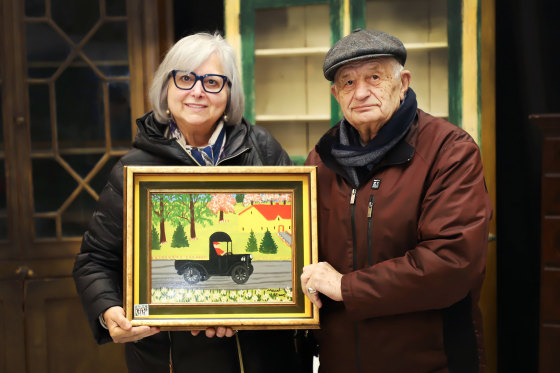
But one of the paintings stopped Demas in her tracks. “There was one special painting that really jumped out at me that was very bright, and it was a little black truck. All the other ones I didn’t care for had about two or three different versions of cats … I was pregnant at that time. And (I thought), ‘Well, if it’s a boy, we can hang it in in his room’ … it turns out I picked the right one.”
Demas did have a boy, and after placing it in a frame with a few letters Lewis sent to Kinnear, she hung the painting in her newborn’s room. Decades passed, and so, too, did the Kinnears. Then came a shift in the art world.
Lewis, a folk artist from Nova Scotia who’d never achieved any financial success for her art, became a topic of interest in the early aughts.
“There was an article written about her in one of the newspapers,” Demas explained, remarking that it wasn’t until around 2000 that she began to hear the familiar name Kinnear had mentioned to her decades before. “More and more people were collecting and buying her art … Things started popping up. I started seeing her art at auction sales. You know, and they were bringing $2,000, $3,000 at that time.”
Then, as Demas recalls, someone found a Lewis painting at a Goodwill store that went up for auction and sold for $45,000.
“But I wasn’t really looking into it because, like I said, we loved the piece,” Demas explained. “We didn’t buy it as an investment or didn’t think that it was a great piece of art even.”
Still, Demas had the foresight to have the piece insured. At the time, Lewis’ art was on the rise but not yet a hot commodity, and the insurers Demas spoke to didn’t recognize the artist’s name. Their ignorance set Demas on a path of appraisal; after talking to auctioneers, she discovered that the black truck was unique. Demas found out that Lewis often incorporated the same images in her art — cats, barns, cows — but the black truck was special. To this day, no one else has reported finding a black truck in a Lewis painting.
Various auctioneers pursued Demas, but two brothers from Miller and Miller were determined. Leaning on the trope that a way to a person’s heart is through their stomach, the two auctioneers drove through sleet and snow to meet Demas and her husband face-to-face and to present them with a box of butter tarts. Not long after their visit, after encouragement from her children, Demas put the piece up for auction.
At a viral auction on May 14, the hammer struck at $272, 548. The letters sold for about $55,000.
Demas recalled the bittersweet sentiment of parting with the painting after decades, but also noted how her earnings will be put to good use. She and her husband Tony are now retired. She works on and off as a private chef, and her husband, who is now 90, has been traveling. Currently, he’s waiting for her to come to join him at the home they own in Athens, Greece.
“He’s over in Greece, and he’s climbing mountains and chasing goats,” Demas said with a smile. “Gathering fresh herbs and waiting for me to come over.”Demas’s relationship with her husband is just one of the many reasons she feels an appreciation for Lewis and her art.
“I think she put so much of herself in these paintings and she just painted happy things because she had such a such a sad life that she wanted to she put everything in her art. She was abused, all her life,” Demas explained, noting her gratitude for her husband, who she says has treated her well in their 50 years together, and whom she’s still very much in love with.
And to think that this story of love, friendship and art all started with a simple sandwich.
“If it weren’t for the grilled cheese, it just would have been another Maud Lewis painting coming up for auction,” Demas said. “I know it would have gone it would have broken all records because it is such a special and unique painting and with the letters, but I think it was the grilled cheese story that really let everybody in the world know was there.”
—
I share this story on National Grilled Cheese Day and out of love for Maud Lewis and her work.
I first learned about Maud Lewis after seeing a movie about her,
‘Maudie,’ the true story of one of Canada’s greatest folk artists.
She had a very hard life, was an incredible natural artist, and I love her art.
—
‘the heart is poured like water through the workings of the hand’
-Laura Jaworcki
—
Source credit: Alex Portée, TODAY Digital





 I didn't have my glasses on....