Category Archives: tradition

haint.

Standard

this is the haint blue ceiling of the porch on the very old house

where we are staying in south carolina

Haint Blue is a term used for a range of pale, blue-green colors that are similar to the color of water or the sky. They’re often used to paint the porch ceilings of homes in the southern United States. The reason people paint their porch ceilings this color is a tale of tradition from the Deep South.

The word “haint” is a colloquial way to pronounce “haunt,” another word for ghosts or evil spirits. The word comes from the Gullah, a community of people descended from West African enslaved people who settled on the coast of Georgia and South Carolina.

The Gullah people  created this color by mixing indigo with lime, milk, and other natural ingredients. They painted porch ceilings, shutters, and even doors in this shade to keep away “haints” aka. restless spirits. The idea was simple but powerful: they believed that haints were afraid of water, spirits couldn’t cross water or sky, and so the color blue would protect the home.

Haint Blue paint was a form of protection for the Gullah and the southern communities embraced it wholeheartedly. That’s why so many porch ceilings throughout the south are painted a beautiful light blue-green, which has become known as haint blue.This  color is tied to memory, protection, and survival.

‘color is a power which directly influences the soul.’

-wassily kandinsky


charleston, south carolina, usa, October 2025

a powerful symbol on indigenous peoples’ day.

Standard

In Navajo (Diné) culture, laughter is considered a powerful symbol of connection. The moment a baby laughs for the first time, it is believed they are choosing to join the human community. Until then, the baby is viewed as still being in transition between the spiritual and physical worlds.

This tradition, known as the A’wee Chi’deedloh ceremony, is typically observed around three months of age. Family members pay close attention during this period, eager to be the one who makes the child laugh. Whoever succeeds earns the honor of hosting the celebration, often preparing a meal of salted food and gifts to mark the occasion.
The ceremony not only celebrates the baby’s first expression of joy, but also emphasizes generosity and community. Salt is symbolically offered to guests to encourage the child to grow up to be generous and kind. It’s one of the earliest social teachings given to a Navajo child, using joy as a path toward belonging and humanity.
Indigenous Peoples’ Day is an official city and state holiday in various localities in the United States that celebrates and honors Indigenous American peoples and commemorates their histories and cultures. It is celebrated on the second Monday in October.

source credits: unity, navajo traditions

dragon.

Standard

on the lunar new year, 2024 – the year of the dragon

may the new year shower you with luck and love

and

may it be as bright as all the lanterns that light up the sky.


art credit: etsy.com

memories gather and dance.

Standard

Toy Department during Christmas season in the J.L. Hudson store, Detroit – 1957

 loved this view of the toy department at the store during the Christmas season.

toys were displayed on shelves, tables, and display cases,

with decorations featuring elves, a sleigh, and reindeer in background.

this is where i went every year

all dressed up fancy

to buy little gifts (with help from the elves) for my family

to see santa

to have a special lunch

 always, always amazed

by the glamour and magic of it all.

“like snowflakes, my christmas memories gather and dance –

each, beautiful, unique, and gone too soon.

-deborah whipp


credits: detroit memories, linda yates rudnicki, j.l. hudson’s

as far as anyone knows…

Standard

not me, nor anyone in my family, but i love the spirit of ‘pocket pancaking’

all families are unique, with their own quirks, traditions, and ways of communicating – and the holiday season often serves as the perfect showcase for these interconnected elements. so when tonight show host, jimmy fallon asked his viewers to tweet funny examples using hashtag #myfamilyisweird, the responses did not disappoint. one person shared their relatives’ tradition of hiding leftover pancakes in each other’s pockets, while another posted a photo of a ‘hideous hand-me-down elf ornament their mother keeps trying to throw away each year, but hilariously ends up back on the tree. customs we cultivate with our kin can do more than just make us laugh, studies have long shown that establishing family routines and rituals positively benefits our health, relationships and well-being.

does your family have any unusual traditions? in my family we had a super creepy automotron mange-y looking furry toy cat that kept coming back. we bought it for a visiting grandie and just thought it was an ordinary stuffed animal, but what we soon discovered was that it would move or make noise at random times. people who received this gift ending up reporting that they kept in their garage or basement or closet, because it creeped them out so much. even with all that, they housed if for a full year, just for the opportunity to ‘gift it’ to someone else in family at the next christmas gathering. people went to great lengths to disguise it when wrapping, so the recipient would let down their guard and open it. we gifted it back and forth to each other for many years, until one year it just disappeared….

“remember as far as anyone knows we’re a nice, normal family.”

— homer Ssmpson

12 grapes.

Standard

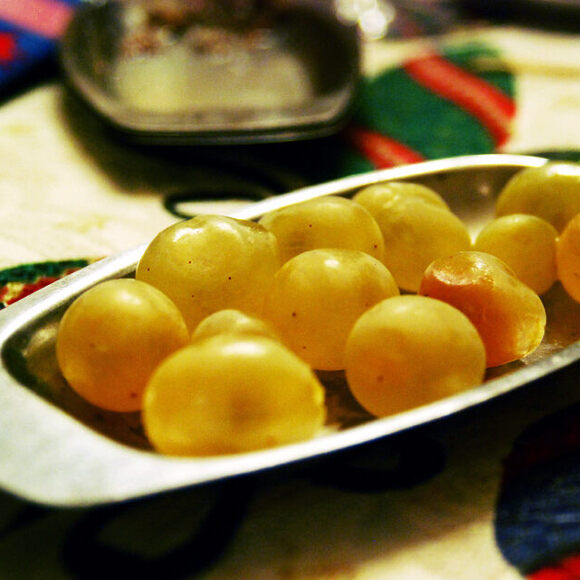
A common story traces the tradition of the twelve lucky grapes, or uvas de la suerte, to grape farmers in Alicante, Spain, who suggested the idea when they had a surplus harvest to unload in the early 1900s. But according to food writer Jeff Koehler, newspaper articles about the tradition from the 1880 suggest it developed from Madrid’s bourgeoisie copying the French custom of drinking champagne and eating grapes on New Year’s Eve.

Either way, Spanish tradition eventually became a superstition that spread to Central and South America. Eating one grape at each of midnight’s 12 clock chimes guarantees you a lucky year—if and only if, you simultaneously ruminate on their significance. (Each grape represents an upcoming month.) If you fail to conscientiously finish your grapes by the time the clock stops chiming, you’ll face misfortune in the new year.

Superstitions tend to be specific, and uvas de la suerte is no different. Most Spaniards eat white Aledo grapes, which farmers in Alicante, Spain, protect from the sun, birds, and other pests by tying paper bags around as they grow. This process, which slows the grapes’ development and allows them to grow a finer skin, produces a grape that’s soft, ripe, and ready to be sold in twelve-packs in December. Now isn’t that lucky?

“you can be drinking the wine today, but picking the grapes tomorrow.”
-jonathan tucker
story and photo credits: gastro obscura, paula mejia

telling the bees.

Standard

The bee friend –  painting by Hans Thoma

The Custom of Telling the Bees

There was a time when almost every rural British family who kept bees followed a strange tradition. Whenever there was a death in the family, someone had to go out to the hives and tell the bees of the terrible loss that had befallen them. Failing to do so often resulted in further losses such as the bees leaving the hive, or not producing enough honey or even dying. Traditionally, the bees were kept abreast of not only deaths but all important family matters including births, marriages, and long absences due to journeys. If the bees were not told, all sorts of calamities were thought to happen. This peculiar custom is known as “telling the bees”.

Humans have always had a special connection with bees. In medieval Europe, bees were highly prized for their honey and wax. Honey was used as food, to make mead, and as medicine to treat burns, coughs, and other ailments. Beeswax candles burned brighter, longer, and cleaner than other candles. Bees were often kept at monasteries and manor houses, where they were tended with the greatest respect and considered part of the family or community. It was considered rude to quarrel in front of bees.

The practice of telling the bees may have its origins in Celtic mythology that held that bees were the link between our world and the spirit world. So if you had any message that you wished to pass to someone who was dead, all you had to do was tell the bees and they would pass along the message. Telling the bees was widely reported from all around England, and also from many places across Europe. Eventually, the tradition made its way across the Atlantic and into North America.

The typical way to tell the bees was for the head of the household, or “goodwife of the house” to go out to the hives, knock gently to get the attention of the bees, and then softly murmur the solemn news.
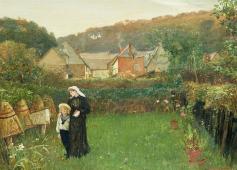
Telling the Bees

A widow and her son telling the bees of a death in the family.

Painting by Charles Napier Hemy 

In case of deaths, the beekeeper also wrapped the top of the hive in black. If there was a wedding in the family, the hives were decorated and cake left outside so that the bees could partake in the festivities. Newlyweds introduced themselves to the bees of the house, otherwise their married life was bound to be miserable.

The intimate relationship between bees and their keepers has led to all sorts of folklore. According to one it was bad luck to buy or sell hives, because when you sell one, you sell your luck with your bees. Instead, bees were bartered or given as gifts. If bees flew into a house, a stranger would soon call. If they rested on a roof, good luck was on its way.

But the relationship between bees and humans goes beyond superstition. It’s a fact, that bees help humans survive. 70 of the top 100 crop species that feed 90% of the human population rely on bees for pollination. Without them, these plants would cease to exist and with it all animals that eat those plants. This could have a cascading effect that would ripple up the food chain. Losing a beehive is much worse than losing a supply of honey. The consequences are life threatening. The act of telling the bees emphasizes this deep connection humans share with the insect.


the rock.

Standard


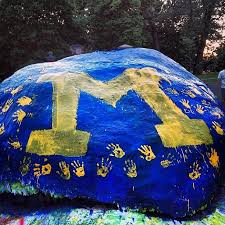
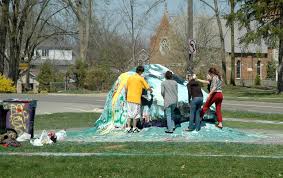
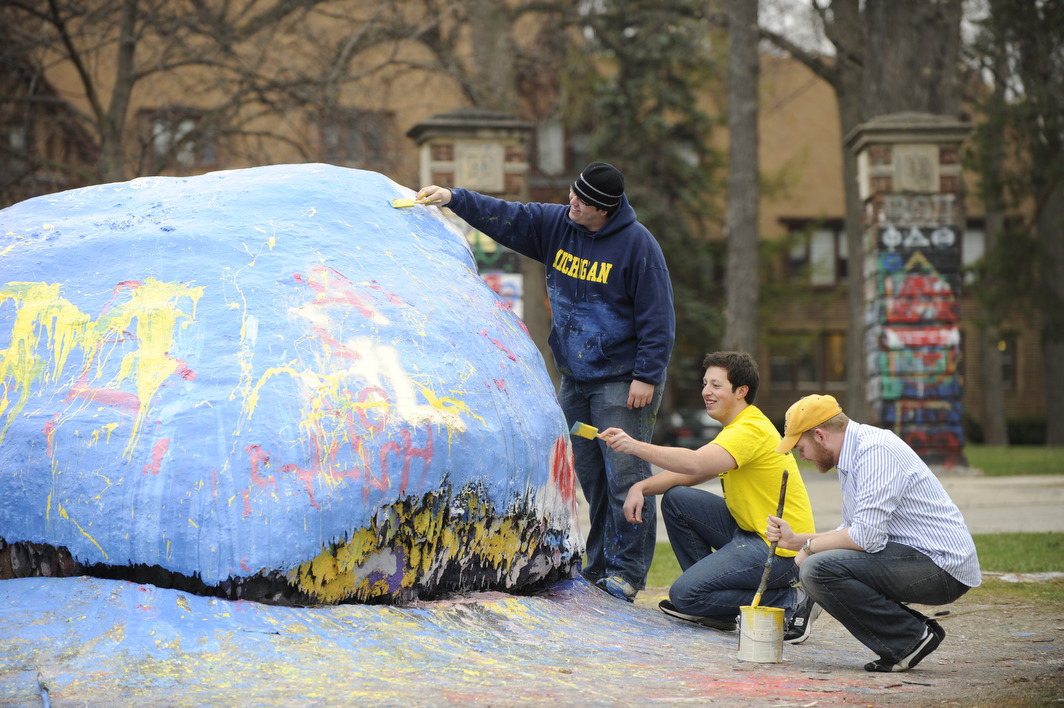
Karen Schaefer took her turn at painting the Rock in Ann Arbor’s George Washington Park, announcing her conclusion about the boulder that was put on the spot in the 1930s. Schaefer wrote her master’s degree thesis on the Rock, (Objects that communicate).

 all kinds of people with all kinds of agendas paint the rock in this decades-old tradition in ann arbor. the chat below was found on my community website and i especially loved how s.a. was at the ready with his how-to directions and a bit of historical support. 

G.A. Does anyone know how much paint is required to paint a message on “The Rock” at Hill and Washtenaw?

P. L. Funny, my husband and I were just talking about this when we drove by it the other day.

S. A.  Old gallon of house paint for the base, one old mop or broom, go to Denny’s down the road, come back and it’s dry for the message.

T. S. Can’t believe that no one has commented that is is illegal and vandalism…

S. A. Even Al Gallup, the living son of the Gallup who placed it there in honor of Washington, is okay with it.

‘passion is one great force that unleashes creativity,

because if you’re passionate about something,

then you’re more willing to take risks.’

—yo-yo ma