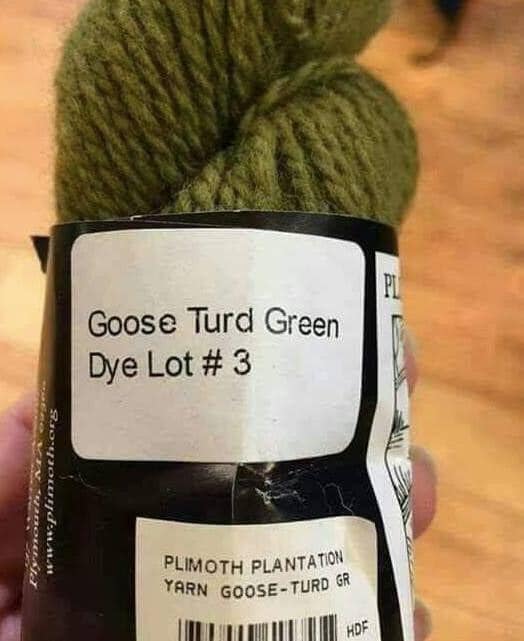
quite accurate, though probably not too popular with the marketing team.
—
“they’ll sell you thousands of greens,.
veronese green and emerald green
and casium green and any sort of green you like;
but that particular green, never.”
-pablo picasso
quite accurate, though probably not too popular with the marketing team.
—
“they’ll sell you thousands of greens,.
veronese green and emerald green
and casium green and any sort of green you like;
but that particular green, never.”
-pablo picasso
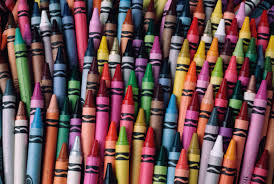
National Crayon Day on March 31 sparks fond memories of childhood creations in full color as we celebrate one of America’s most beloved toys, the crayon! Crayons delight our senses not just with their brilliant colors but also with their distinct smell, the feel of them in our hands, and for some kids, the waxy taste. With over 12 million crayons made daily, one is never far from reach. So, grab your box of 64 crayons, sharpener included, and get ready for some artistic expression and nostalgia.
Crayons have a colorful history. While hued wax molds have existed for centuries, the modern-day crayon got its start in the 1900s. Crayola crayons were introduced in 1903 by Binney & Smith as a safer and cheaper alternative to the art utensils in use at that time. Binney & Smith premiered their famous eight-pack of crayons with the color line-up: Black, Brown, Orange, Violet, Blue, Green, Red, and Yellow. This color mix, along with their names, remained unchanged for 45 years. Since then, many colors have been added, color names and packaging have changed, and color styles such as neon, metallics, and glitter have emerged. A few colors have even been retired from the color wheel, typically on March 31.
The Crayola crayon has a special place in the hearts of Americans and Americana. It was one of the original inductees into the National Toy Hall of Fame in November 1999. It is estimated the average American will have used 730 crayons by their 10th birthday. Even Mr. Rogers has had his hand in the history of crayons by molding the official 100 billionth crayon in February 1996 at the Crayola plant in Easton. Crayons not only add color to our lives, but they’ve also been held as an analogy for the colorfulness of the human race and our ability to live together in a diverse world. Crayons have been used for creating artwork for years.
Originally used for industrial purposes, their popularity soared when the brand Crayola was introduced. Crayons are used as a medium for creating artwork by children in schools mostly, but is also popular among adults who use it for creating contemporary art. Many households have a box of crayons stashed away somewhere, and today is the day it is pulled out. Everyone can enjoy crayons for creating vivid drawings.
BY THE NUMBERS
100 – the number of colors Crayola crayons are available in.
50 – the number of crayon colors retired by Crayola.
3 billion – the number of crayons produced by Crayola in a year.
18th – the ranking in terms of how familiar the crayon scent is to adults.
1962 – the year when Crayola changed the name of their crayon ‘Flesh’ to ‘Peach.’
15 feet – the length of the world’s biggest crayon.
223 billion – the number of Crayola crayons produced to date.
730 – the number of crayons used by the average kid by the age of 10.
—
“we could learn a lot from crayons; some are sharp, some are pretty, some are dull, while others bright, some have weird names, but they all have learned to live together in the same box.”
-Robert Fulghum, american author
—
credits: national days
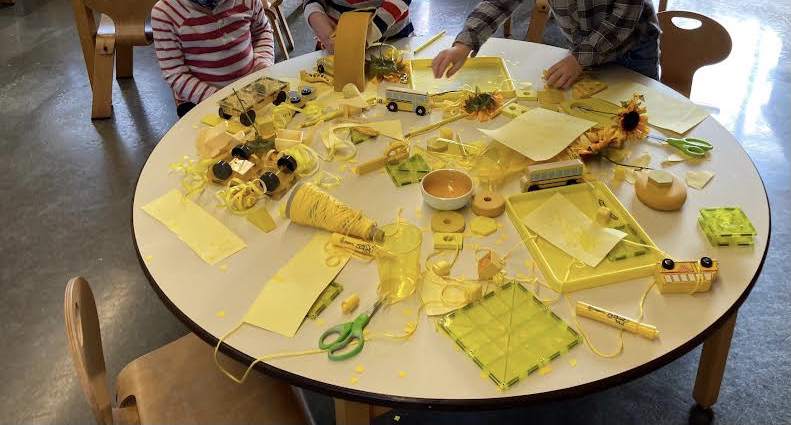
the kinder create with loose parts
dressed all in yellow.
clearly in their yellow period.
—
“yellow is the color which is closest to light.
we associate the rays of the sun and the stars with it.
it is the radiance of the spirit.”
– ueli seiler-hugova
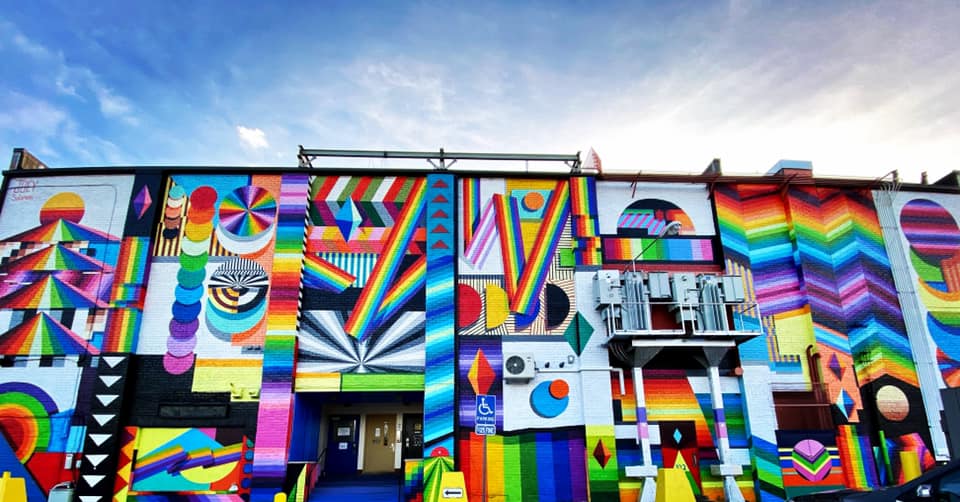
Ann Arbor has innumerable large- and small-scale murals already, but they have new company as the result of a crowdfunded project to bring art to walls and alleys around town.
In July, the Ann Arbor Art Center (A2AC) raised more than $50,000 to commission 10 murals around the city. The fundraiser was through Patronicity, and once the goal was met, the Michigan Economic Development Corporation (MEDC) matched the donations to double the money available to the mural artists. At the onset of the project, 10 artists paired with local business owners on the sites of their future murals. In October, two additional murals were announced, raising the total to 12. This initiative is part of the ongoing A2AC Art in Public program that aims to make art “accessible and equitable to everyone,” relying on community-based donations.
Since the Art Center helped crowdfund two other public murals in the recent past, those have been added to the A2AC Murals Map, which features a walking tour of all the works. Currently, 13 murals are finished, with the 14th debuting sometime in 2021.
“one can speak poetry just by arranging colors well.”
-vincent van gogh
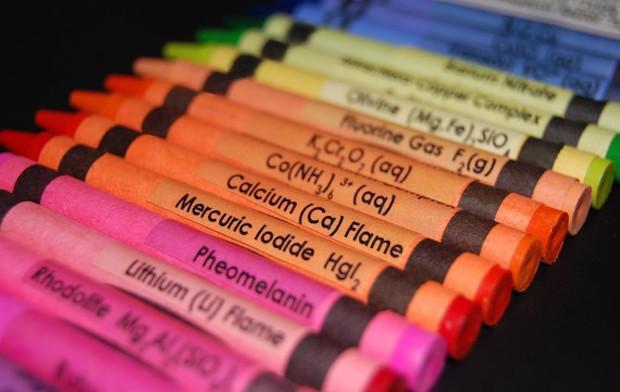
periodic table crayon covers teach kids science through coloring
one of the best ways to capture a child’s imagination is with a box of crayons. etsy shop ¡Que Interesante!, which calls itself a place “where geek meets art,” has created special labels for crayons and colored pencils to help kids learn about the elements of the periodic table, and their chemical reactions, while coloring.
¡Que Interesante! used the flame test, a qualitative test in which the chemical makeup of a compound is identified by the color it gives off when placed in a flame, to match chemicals to colors.
“so,” according to the company, “instead of thinking, ‘i want green’ they will think ‘i want Barium Nitrate Ba(NO3)2 Flame’ and then when they take chemistry in high school and their teacher sets some gas on fire and it makes a green color and they ask the class what chemical it was your student will know it was barium.”
—
“as long as chemistry is studied, there will be a periodic table.
and even if someday we communicate with another part of the universe,
we can be sure that one thing both cultures will have in common
is an ordered system of the elements that will be instantly recognizable
by both intelligent life forms.
—john emsley, nature’s building blocks: an A-Z guide to the elements
—
credits: etsy, mental floss, r.obias, que interesante
– great news –
there are now
officially
two words
that rhyme with purple.
hirple, meaning “to limp” or “walk awkwardly,”
and
curple, an old Scots word for the hindquarters of a horse.

now about orange……
—
credits: google images, mental floss magazine
Most of the basic English names for colors—like red, yellow, green, and blue—are amongst the oldest recorded words in our language and can be traced right back to the Old English period. One exception to that rule is the color orange, which didn’t begin to appear in the language until after oranges (the fruit) were imported into Britain from Europe in the Middle Ages. Before then, what we would describe as orange today had just to be called either “red” or “yellow” (or, if you wanted to be really specific, “red-yellow”). But the English language being as enormous as it is, a predictably enormous vocabulary of words have been invented, borrowed, and accumulated over the centuries to describe almost every color and shade imaginable—from the precise color of a bear’s ears, to the murky green of goose droppings. Nineteen brilliantly-named examples of colors you’ve probably never heard of are listed here.
1. AUSTRALIEN
The 1897 guide House Decoration, Whitewashing, Paperhanging, Painting, Etc. includes, in a chapter dedicated to mixing oil paints, “a list of new colors for ladies’ dresses,” among which is listed australien. Inspired by the rusty color of the rocks and deserts of the Australian outback, the name australien was used by dressmakers and fashion houses in late Victorian England for a deep orange color.
2. BANAN
The color of a ripe banana? That’s banan.
3. BASTARD-AMBER
Bastard-amber is the name of an amber-colored spotlight used in theaters to produce a warm peach or pink glow on stage. It’s often used to recreate sunlight, or to give the illusion of dawn or dusk.
4. DRAKE’S-NECK
The drake in question here is the male mallard, a species of duck found across North America, Europe, and Asia. The males have an iridescent bottle-green head and neck, which gave its name to rich green-colored dye called drake’s-neck in the early 18th century.
5. DRUNK-TANK PINK
Drunk-tank is the name of a bright shade of pink that has been the subject of a number of studies on the effects of colors on human temperament since the mid-1960s. This particular color—also known as Baker-Miller pink, after the two U.S. Navy officers who invented it—has been demonstrated in numerous experiments to have a calming influence, and so is often used in prisons and police holding cells to help keep inmates relaxed and to discourage unruly behavior.
6. FALU
Falun is a small city in central Sweden renowned for its copper mining industry. Since the mid-16th century (at least), all of the wooden homes, barns, outhouses and other buildings in and around Falun have been traditionally painted a deep rust-red color known as falu that is manufactured from the iron-rich waste materials left over from the mines.
7. FLAME-OF-BURNT-BRANDY
As the dyeing industry developed in the 19th century and was able to produce more and more colors, dressmakers and designers were left to concoct a whole range of weird and wonderful names for the new colors at their disposal. Flame-of-burnt-brandy was just one of them, described in 1821 by one ladies’ magazine as a mixture of “lavender grey, pale yellow, and dark lilac.” Other equally evocative names dating from the same period include dragon’s blood (a deep purplish-red), d’oreille d’ours (a rich brown, literally “bear’s ears”), elephant’s breath (steel grey) and flamme de Vesuve (“the flame of Vesuvius,” or the color of lava).
8. GINGERLINE
Not just another word for anything ginger-colored, gingerline is actually a 17th century English alteration of the Italian word for “yellow,” giallo, and describes a rich orange-yellow. According to one description, it refers very precisely to the color of ripe kumquats.
9. INCARNADINE
Incarnadine is an etymological cousin of the adjective “incarnate,” meaning “having bodily form.” In this sense it literally means flesh-colored, but Shakespeare used it to mean blood-red in Macbeth, and nowadays it’s usually used to refer to a rich crimson or dark-red color.
10. LABRADOR
Not, as you might think, the color of a Labrador dog, labrador is actually a shade of blue that takes its name from the mineral labradorite, a turquoise form of feldspar.
11. LUSTY-GALLANT
Lusty-gallant was originally the name of a dance popular in Tudor England, but somehow, in the late-1500s, its name became attached to a pale shade of red, similar to coral pink. Quite how or why this happened is unclear, but according to the Elizabethan writer William Harrison, dressmakers at the time had a habit of giving increasingly bizarre names to the colors of their clothes in the hope of making them more appealing to buyers. In his Description of England, written in 1577, Harrison lists the names of several “hues devised to please fantastical heads,” including “gooseturd green, pease-porridge tawny, popinjay blue, lusty-gallant, [and] the-devil-in-the-head.”
12. NATTIER
Jean-Marc Nattier (1685-1766) was a French rococo artist known for a series of portraits of women from the court of Louis XV of France depicted as characters from Greek mythology. Despite achieving enormous popularity during his lifetime—his contemporaries thought his work so exquisite that they even accused him of painting with makeup rather than paint—Nattier is relatively little-known today, but he lives on in the name of a deep shade of slate-blue that he used in a number of his paintings, most notably a portrait of The Comtesse de Tillières (1750), nicknamed “The Lady in Blue.”
13. PERVENCHE
Pervenche is the French word for periwinkle, which came to be used in English in the 19th century as another name for the rich purplish-blue color of periwinkle flowers.
14. PUKE
Fortunately, when William Shakespeare wrote of a “puke-stocking” in Henry IV: Part 1 (II.iv), he didn’t mean anything having to do with vomit. In 16th century England, puke was the name of a high quality woolen fabric, which was typically a dull, dark brown color.
15. SANG-DE-BOEUF
Unsurprisingly sang-de-boeuf, or “oxblood,” is the name of a rich shade of red that was originally a blood-colored pottery glaze made by heating copper and iron oxide at a very high temperature. Although the name sang-de-boeuf dates back no further than the late 19th century, the technique used to manufacture oxblood glazes was first developed as far back as the 1200s in China.
16. SINOPER
Popular amongst Renaissance artists, sinoper or sinople was an artist’s pigment containing particles of hematite, an iron-rich mineral that gave it a rich rust-red color. Its name comes from the town of Sinop on the Black Sea coast of Turkey, from where it was first imported into Europe in the late Middle Ages.
17. VERDITER
Verditer is both an old fashioned name for verdigris, the green rust-like discoloration of copper and brass, and the name of blue-green pigment dating from the 1500s. Its name, which is derived from the French verte-de-terre, or “green of the earth,” is today used in the name of a bright turquoise songbird, the verditer flycatcher, which is native to the Himalayas.
18. WATCHET
Watchet is a very pale blue color, similar to sky blue. According to folk etymology, the color takes its name from the town of Watchet on the coast of Somerset in southwest England, the cliffs around which appear pale blue because they are rich in alabaster. As neat a story as this is, however, it’s much more likely that watchet is really derived from waiss, an old Belgian-French word for royal blue.
19. ZAFFRE
Zaffre is the name of an ancient blue pigment originally produced by burning ores of cobalt in a furnace. Its name was borrowed into English from the Italian zaffera in the 17th century, and is ultimately descended from the Latin word for “sapphire.”
—
credits: mentalflossmagazine.com, unprsouth.com
 I didn't have my glasses on....