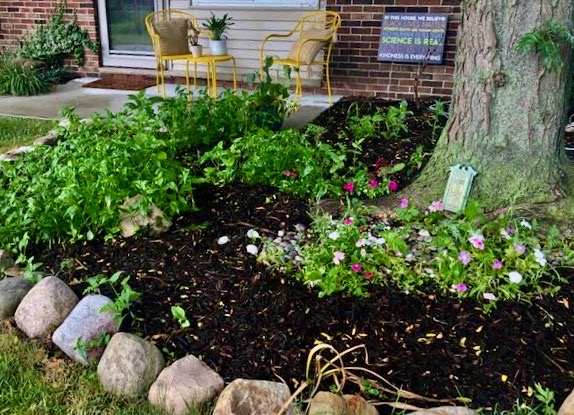
always hear what the sheep has to say.
Feb1
she was in the checkout line just in front of me
something about her looked tired
like her shoes
world weary
her cart filled with simple things
beans, bread, eggs, milk, cans, pasta
and what looked to be a special treat
one small bright orange
maybe for someone little waiting at home
when it was her turn
she paid
with what was left on her food card
then tried a credit card
and still
didn’t have quite enough
she looked back at me
with apologetic eyes
sorry for the trouble
she fumbled in her purse
looked to see
what she could put back
not sure what to do
I heard the clerk tell her
that she needed
one dollar and seventy cents more
my heart went out to her
not knowing her life
I said that I had that money
I was happy to give it to the clerk
she looked at me with shy eyes
nodded thank you
carried her bags out
and I thought about
how that one small orange
would make such a difference
for someone special
maybe
my small act
had made a difference
in her life too
made it
a bit easier
just for a moment
and at that moment
I knew
there was absolutely
no finer way in the world
for me to have spent
just one dollar and seventy cents.
—
‘remember that the biggest thing you could do today is a small act of kindness.’
-cory booker
after making the decision
to challenge my traffic ticket
(I’m innocent, for the record)
my scheduled hearing
has been adjourned twice.
in today’s mail
I received the new date
for my next potential hearing.
I had to laugh
when I picked up the new envelope
(for the third time now)
and it once again clearly read:
Defendant
just above my name
with the court address In the return corner
I have to wonder
just what major crime
my mr. rogers sweet and friendly mailman
thinks I may have committed?
‘we find the defendants incredibly guilty.’
– mel brooks
Beneath The Sweater And The Skin
How many years of beauty do I have left?
she asks me.
How many more do you want?
Here. Here is 34. Here is 50.
When you are 80 years old
and your beauty rises in ways
your cells cannot even imagine now
and your wild bones grow luminous and ripe,
having carried the weight
of a passionate life.
When your hair is aflame
with winter
and you have decades of
learning and leaving and loving
sewn into
the corners of your eyes
and your children come home
to find their own history
in your face.
When you know what it feels like to fail
ferociously
and have gained the
capacity
to rise and rise and rise again.
When you can make your tea
on a quiet and ridiculously lonely afternoon
and still have a song in your heart
Queen owl wings beating
beneath the cotton of your sweater.
Because your beauty began there
beneath the sweater and the skin,
remember?
This is when I will take you
into my arms and coo
YOU BRAVE AND GLORIOUS THING
you’ve come so far..
I see you.
Your beauty is breathtaking.
—
Credits: Author: Jeannette Encinias, Studio Yuki Photography, Thank you Russ Thomas

Scanning electron microscope image of one of the clumps of presolar grains, or stardust. Image via Janaína N. Ávila/EurekAlert!
Grains of stardust – particles left behind by star explosions – in an Australian meteorite are now the oldest known material on Earth. A new study suggests this stardust came to be long before our sun ever existed.
As the saying goes, we are all made of stardust. It’s true. The elements in our bodies – oxygen, carbon, nitrogen, calcium and so on – are made in the thermonuclear furnaces of stars. When scientists speak of stardust, or cosmic dust, they’re speaking of the leftover tiny particles from dead stars that exploded as supernovae. This stardust later goes into forming new stars, planets and moons, including those in our own solar system. It goes into the solar system’s debris, the asteroids and comets, and ultimately meteorites, or rocks from space that find their way to Earth’s surface. Now scientists at the Field Museum in Chicago have found the oldest known samples of stardust in a meteorite that landed in Australia. The meteorite is estimated to be 5 to 7 billion years old. The stardust samples are the oldest material ever discovered on Earth. This dust is even older than our solar system.
The new peer-reviewed study was published in Proceedings of the National Academy of Sciences on January 13, 2020.
—
credits: SPACE – Paul Scott Anderson, Proceedings of the National Academy of Science, Earth Sky, Chicago Field Museum, Phillip Heck