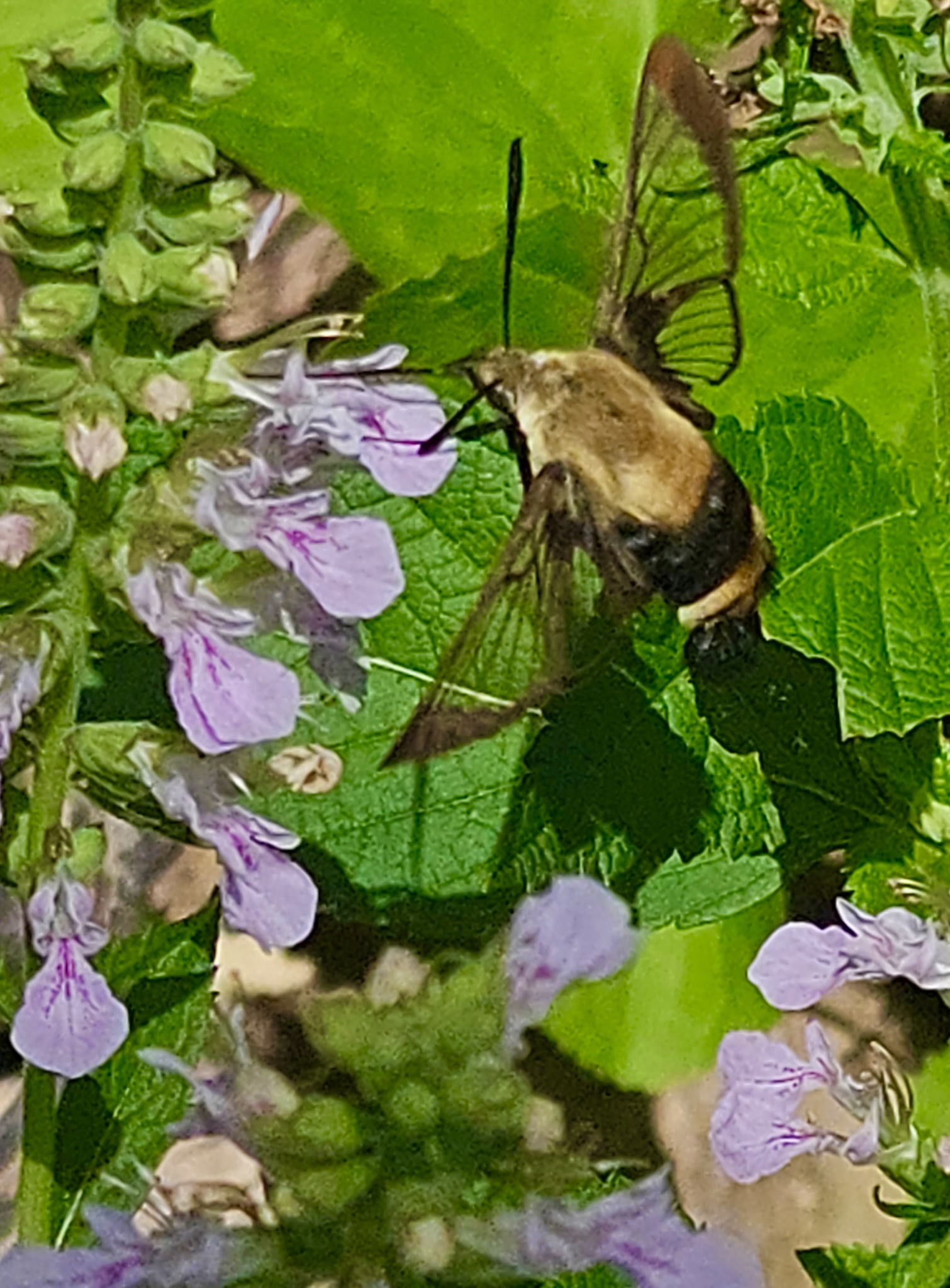
hummingbird moth (Strawberry Clearwing) on an american germander plant
enjoying a visit to my daughter’s native garden
—
Hummingbird moths have been seen as a lucky omen. Lore has it that a swarm of the moths was seen flying across the English Channel on D-Day, the day of the Normandy landings in WWII.
One of the sweetest insect visitors in a garden is the hummingbird moth. They fly and move just like hummingbirds. Like them, they can remain suspended in the air in front of a flower while they unfurl their tongues and insert them in flowers to sip their nectar. They even emit an audible hum like hummingbirds. Often people notice what they think is a tiny hummingbird fleeting around the flowers and are shocked when someone explains to them that what they just saw was not a bird but a moth.
Hummingbird moths are rather plump; the tip of their tail opens into a fan. Their wings are covered by scales; some species lose many of the scales from patches on their wings, so are called clearwing hummingbird moths. They are tiny and have a body length of 1-2 inches and a wingspan of 1.5-2.5 inches. Like most moths they have a very long tongue which they carry rolled under their chins and that they use to reach the nectar of long-necked flowers. Such nectar is inaccessible to many other flower visitors, so it seems that these flowers prefer long tongued pollinators and try to keep the others away.
—
moth-ku
sweet hummingbird moths
flying beauties flitting wings
may just be fairies
—
bk
—
photo credit: oldest daughter, HP
source credits: *Phillip Prichard, University of Georgia, U.S. Forest Service, Discovery Journal, Native Suburbia
*Phillip Prichard, is a Paulding UGA Extension Master Gardener, Master Birder, and a UGA Master Naturalist, who teaches horticulture, sustainable landscaping, and environmentally friendly gardening practices using unbiased, research-based information from the University of Georgia.

