Refugee Who Paints With a Toothbrush Nominated for Prestigious Art Prize: “My Message Is Love”
For artist Mostafa “Moz” Azimitabar, no paintbrush is as special as the humble toothbrush
Facing persecution in his birth country of Iran, the Kurdish artist and musician fled to Australia in 2013. Once there, he was entered into the immigration system and would spend the next eight years in detention centers. At his first stop, an offshore camp on Manus Island, Papua New Guinea, Azimitabar turned to art to cope with his emotions.
“I asked one of the officers on Manus: ‘Can I have some paint?’… I would like to do some artwork because I don’t want to give up’,” he recalled. The guard refused his request, citing safety concerns. Azimitabar returned to his shared room, frustrated, but refusing to let it go. The reality of his situation forced him to get even more creative. He decided to work with what he had — in this case, coffee and a toothbrush.
“I don’t know what happened … that moment was so special for me. I grabbed the toothbrush and I put it in the coffee and I just dragged it (on some paper),” he said, calling it a “moment of victory.” He continued to experiment with the technique throughout his detainment. “Art and painting helped me to be strong, to continue. Because when I paint, I don’t feel any trauma.”
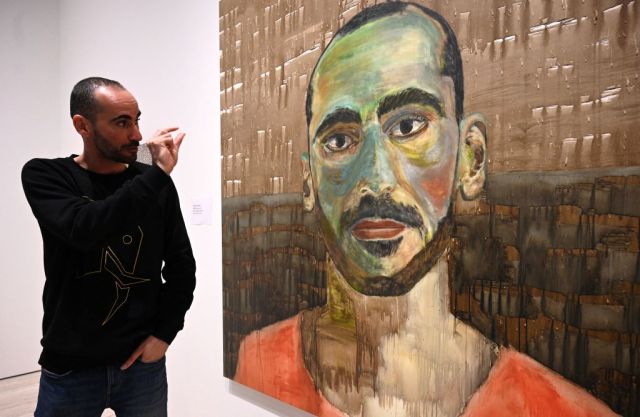
Then, another moment of victory came over a year after his release in 2021: He was named a finalist for the Archibald Prize, one of Australia’s most prestigious art awards, worth over $70,000. His painting, one of 52 chosen from over 800 submissions, was created using a toothbrush, coffee, and acrylics on canvas. It’s titled “KNS088,” the number the Australian government issued him during his years in detention.
Azimitabar wrote, “I made this self-portrait to share my story. My face looks outwards, showing the suffering I have experienced, but also my strength and determination.”
—
“The message of my painting is love. We are all one family, connected by our humanity.”
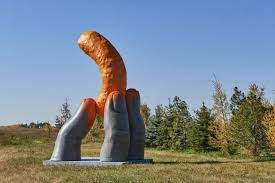
The Cheetos brand erected the statue of a hand holding a massive Cheeto, immortalizing the sticky orange residue that Cheetos leave on your fingertips, in Cheadle, Alberta. The community was chosen because of its name’s similarity to “cheetle,” the company’s official name for Cheeto dust.
“Cheetos fans have always known that the delicious, cheesy dust on their fingertips is an unmistakably delicious part of the Cheetos experience, but now it officially has a name: Cheetle,” said Lisa Allie, the senior marketing director at PepsiCo Foods Canada, which distributes Cheetos in the country.
“We’re excited to be celebrating Cheetle and Canadians’ cheesy, Cheetle-dusted fingertips on such a grand scale, (17-feet tall), and in such a uniquely mischievous way.”
The unique piece of art won’t stay in Cheadle forever, however, according to Cheetos’ news release. Cheadle residents and visitors can check out the big, cheesy fingers until Nov. 4. Then, the monument will embark on a tour of other locations in Canada.
Cheadle is a hamlet located in Alberta’s Wheatland County. Its population is tiny: Just 83 people lived there in 2021, according to the Canadian census.
*note – as a huge fan of ‘flamin’ hot cheetos,’ i fully endorse this artistic endeavor
—
“I love Cheetos, those hot, spicy kind. And chocolate.
Every time I’m in the airport I’m buying Cheetos and eating them on the airplane.”
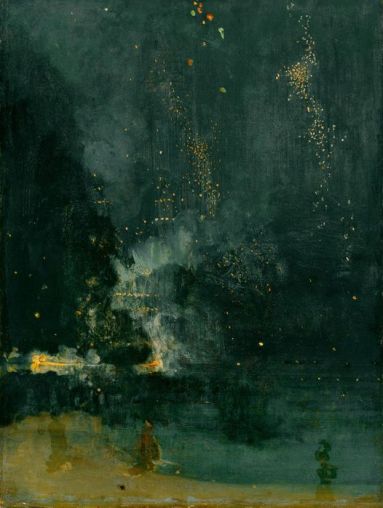
*This work, which is a depiction of a fireworks display in London’s Cremorne Gardens, is probably Whistler’s most infamous painting. It was the central issue of a libel suit that involved the art critic John Ruskin and the artist. Ruskin had publicly slandered the work by making the statement, “I have seen, and heard, much of cockney impudence before now; but never expected to hear a coxcomb ask two hundred guineas for flinging a pot of paint in the public’s face.” Whistler won the libel suit; however, he was awarded only the token damages of one farthing. This is one of Whistler’s many “Nocturnes,” which are characterized by a moody atmosphere, a subtle palette, and overall tonalist qualities.
—
“there is only one way to avoid criticism, do nothing, be nothing, say nothing.”
-aristotle
—
*art: James Abbott McNeill Whistler, Nocturne in Black and Gold, the Falling Rocket,
1875, oil on panel. Detroit Institute of Arts, Gift of Dexter M. Ferry, Jr.
“creative expression is not just a means of getting attention, although some have approached art that way. think of art as a way of connecting, of sharing your insights with others.”
At This Once-Secret Exhibition, the Met’s Security Guards and Staff Display Their Own Art
For the first time since 1935, the show is finally open to the public
More than 450 pieces made by Met staff members are on display in this year’s exhibition. Photo by Eileen Travell / Courtesy of the Metropolitan Museum of Art
Every two years, staff members at New York City’s Metropolitan Museum of Art get the chance to display their own creations on the institution’s hallowed walls. Since the tradition started in 1935, the exhibition has been something of a secret, open only to employees and their guests, Hyperallergenic’s Elaine Velie reports. But now, for the first time, the show is open to the public.
“Art Work: Artists Working at the Met” features hundreds of pieces—including paintings, drawings, photographs, sculptures and digital installations—made by guards, librarians, conservators, educators, registrars and others who work at the Manhattan museum. More than 450 of the Met’s 1,700 employees contributed to the exhibition, which is held in the space next to the museum’s ancient Greek sculpture hall, Hyperallergic notes. The show accepts all staff-made submissions, which are installed by Met staff members working extra hours.
Daniel Kershaw, a Met exhibition design manager who has overseen the show’s curation for more than two decades, says he identifies themes that unify the disparate submissions, grouping pieces that work well together (for example, landscapes go next to other landscapes). This year’s show includes a photograph of Cuba, an oil painting of a partially frozen pond, a series on Black life in Brooklyn’s Crown Heights neighborhood, and jars and cans painted to look like tiny monsters, among other works.
Until this year, museum officials and employees were extremely furtive about the exhibition—so much so that the New York Times’ Corey Kilgannon struggled to find sources for a 2012 story on the show. When he visited the Met and asked guards about it, they told him they were forbidden to discuss it with the press.
After some more digging, Kilgannon found a few guards willing to talk, including Peter J. Hoffmeister, who expressed concerns about the secrecy around the event. “It’s complicated to have artists working for you who want their art on the walls—I understand that,” Hoffmeister told the Times. “But as an artist I think it should be public, because keeping it private defeats the purpose of having an art show.”
Some of the Met’s employees are artists who work at the museum to supplement their income, while others make art as a hobby, according to Hyperallergic. But everyone who submits to the show is balancing their art with their day jobs.
Back in 2012, one such individual was Christoper Boynton, a painter, photographer and museum guard. At the time, Boynton didn’t know why the show was closed to the public. “Maybe it’s because they would have to insure the art in the show,” he told the Times. “Maybe it’s that, if someone’s artwork is shown at the museum, people may think it’s being sanctioned by the museum.”





:focal(4096x2731:4097x2732)/https://tf-cmsv2-smithsonianmag-media.s3.amazonaws.com/filer_public/a2/08/a208b836-e73e-4a7c-b63c-4d7a1b9f1ecd/76a5151.jpg)
 I didn't have my glasses on....