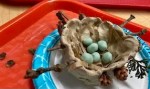
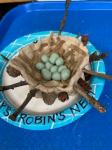
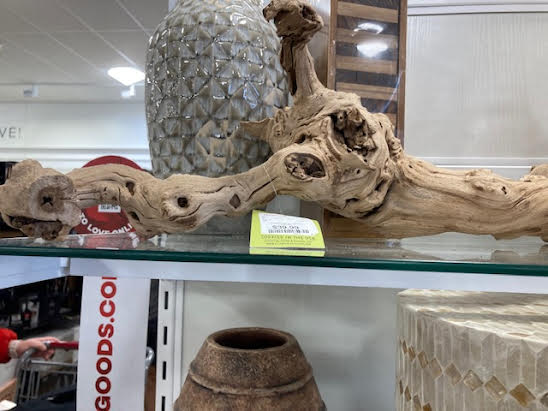
robin’s nests created by the kinder using natural materials
clay, twigs, pinecones, clippings
any robin would be happy to raise her babies in one of these beautiful homes
—
“wildness we might consider as the root of the authentic spontaneities of any being. it is that wellspring of creativity whence comes the instinctive activities that enable all living beings to obtain their food, to find shelter, to bring forth their young; to sing and dance and fly through the air and swim through the depths of the sea. this is the same inner tendency that evokes the insight of the poet, the skill of the artist, and the power of the shaman.”- thomas berry
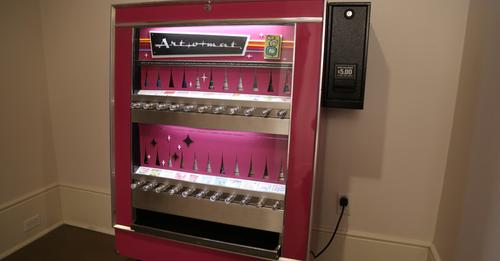
The Art-o-mat in Milwaukee is an art installation and interactive exhibit that used to be a retro cigarette vending machine, but now it’s an art dispenser. For just $5, people can get a print, painting, jewelry, statue, and so much more.
“It is so much more than a vending machine. It’s an art experience, but it’s also an art object in and of itself,” Samantha Timm, the curator at Saint Kate The Arts Hotel in Milwaukee, Wisconsin, said.
Since Saint Kate opened in 2019, the Art-o-mat has been a huge hit.
“We sold almost 10,000 pieces, so it just gives you an idea that people are excited about it and they want to participate,” Timm said.
The first Art-o-mat was built by Clark Whittington in 1997. He refurbished an old cigarette vending machine after it became more or less illegal. He displayed it at an art exhibition, and it became a huge hit. Now, he leases them out to galleries, libraries, and hotels.
It’s not cheap to have one. It can cost $5,000 per year. Plus, it costs $2.50 plus shipping to stock the machine. However, it’s not about making a ton of money. These exhibits are designed to be a fun way to interact with art and the past. Furthermore, it makes art collecting accessible for buyers. All the art inside the machines is made by different artists from around the world.
“It’s so unique. It’s so different. I’ve never seen anything like this,” Kami Strunsee, an artist and owner of Timber Lane Studio and Gallery in Wales said.
Strunsee also has an Art-o-mat in her gallery. She estimates more than 500 pieces of cigarette box-sized art has been purchased since she opened in April 2022. Strunsee also discovered that there is an entire community of people who collect pieces of art from these vending machines.
“I have several people from California come in. They came to Wisconsin, and they just drove east, and were trying to hit as many Art-o-mats as they could,” she said.
Strunsee has even hosted Art-o-mat nights. People come in with their friends, buy a few pieces of art, and then sit around a table looking at each other’s collectibles and making trades with each other just like one would with basketball or Pokemon cards. “It’s kind of random as to what you get but it’s always something really unique,” she said.
—
“i do not want art for a few any more than education for a few, or freedom for a few.” -william morris
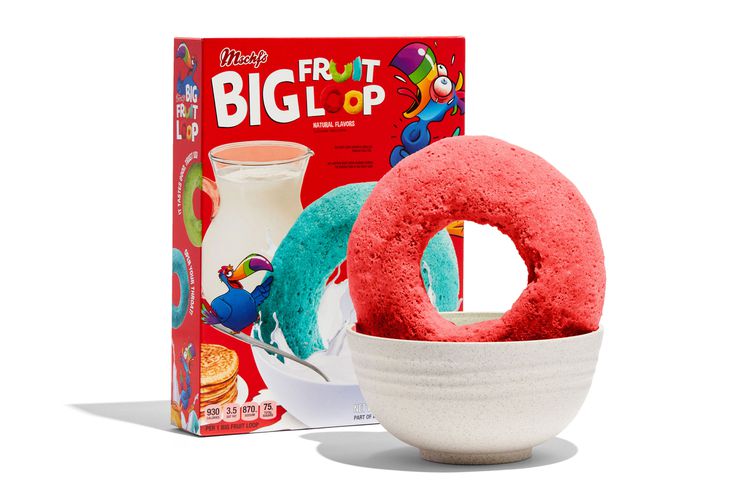
A single serving of Kellog’s Froot Loops cereal clocks in at one and one-third cups, weighs 39 grams, and contains 150 calories, according to the nutrition facts printed on the side of the box. Though we’ve never actually counted how many loops are in that single serving, we assume it’s more than one. Oh, you only want one? OK then. Big Fruit Loop is here to deliver.
The Big Fruit Loop is just as the name implies: a single massive loop. It’s also a very much unauthorized version of the longtime breakfast cereal, and it’s the latest drop from Brooklyn-based art collective MSCHF.
That one big loop contains 930 calories and weighs around half a pound, or the equivalent of about half a box of regular Froot Loops mashed into one bowl-filling monstrosity. There’s absolutely no reason for it to exist, which seems to be exactly why MSCHF decided to create it.
“With MSCHF, we are always looking at cultural readymades we can play with,” Daniel Greenberg, MSCHF’s co-founder, told Food & Wine via email. “Cereal is, of course, one of those things. When looking at the object and thinking about what we could do with it, enlarging it to fit the size of the box seemed too perfect to pass up.”
Greenberg declined to explain what the production process for the Big Fruit Loop was like, other than to admit that “it was not easy.” He also said that the company had to reverse-engineer its loop to match the flavor of the Kellogg’s originals. To Greenberg, the two kinds of cereal taste “almost identical.” You know, minus one being gigantic and all.
—
“you may not know this but it’s impossible to open a box of ‘fruit loops’ and just eat the fruit,
let someone else have the loops”
― neil leckman
—
credits: food and wine magazine, stacey leasca, photo credit: MSCHF
Refugee Who Paints With a Toothbrush Nominated for Prestigious Art Prize: “My Message Is Love”
For artist Mostafa “Moz” Azimitabar, no paintbrush is as special as the humble toothbrush
Facing persecution in his birth country of Iran, the Kurdish artist and musician fled to Australia in 2013. Once there, he was entered into the immigration system and would spend the next eight years in detention centers. At his first stop, an offshore camp on Manus Island, Papua New Guinea, Azimitabar turned to art to cope with his emotions.
“I asked one of the officers on Manus: ‘Can I have some paint?’… I would like to do some artwork because I don’t want to give up’,” he recalled. The guard refused his request, citing safety concerns. Azimitabar returned to his shared room, frustrated, but refusing to let it go. The reality of his situation forced him to get even more creative. He decided to work with what he had — in this case, coffee and a toothbrush.
“I don’t know what happened … that moment was so special for me. I grabbed the toothbrush and I put it in the coffee and I just dragged it (on some paper),” he said, calling it a “moment of victory.” He continued to experiment with the technique throughout his detainment. “Art and painting helped me to be strong, to continue. Because when I paint, I don’t feel any trauma.”
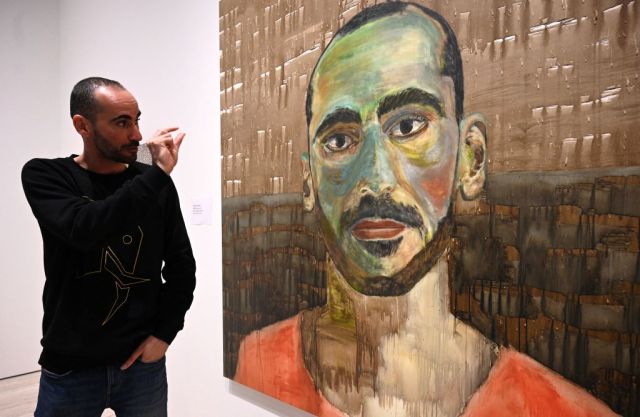
Then, another moment of victory came over a year after his release in 2021: He was named a finalist for the Archibald Prize, one of Australia’s most prestigious art awards, worth over $70,000. His painting, one of 52 chosen from over 800 submissions, was created using a toothbrush, coffee, and acrylics on canvas. It’s titled “KNS088,” the number the Australian government issued him during his years in detention.
Azimitabar wrote, “I made this self-portrait to share my story. My face looks outwards, showing the suffering I have experienced, but also my strength and determination.”
—
“The message of my painting is love. We are all one family, connected by our humanity.”
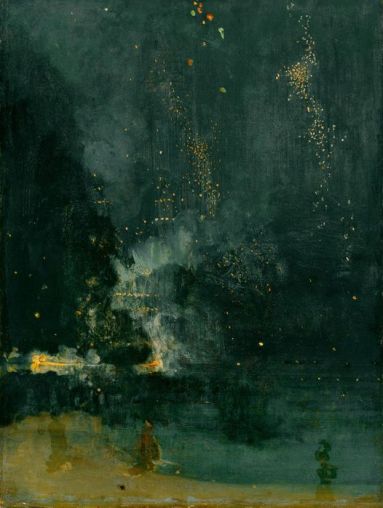
*This work, which is a depiction of a fireworks display in London’s Cremorne Gardens, is probably Whistler’s most infamous painting. It was the central issue of a libel suit that involved the art critic John Ruskin and the artist. Ruskin had publicly slandered the work by making the statement, “I have seen, and heard, much of cockney impudence before now; but never expected to hear a coxcomb ask two hundred guineas for flinging a pot of paint in the public’s face.” Whistler won the libel suit; however, he was awarded only the token damages of one farthing. This is one of Whistler’s many “Nocturnes,” which are characterized by a moody atmosphere, a subtle palette, and overall tonalist qualities.
—
“there is only one way to avoid criticism, do nothing, be nothing, say nothing.”
-aristotle
—
*art: James Abbott McNeill Whistler, Nocturne in Black and Gold, the Falling Rocket,
1875, oil on panel. Detroit Institute of Arts, Gift of Dexter M. Ferry, Jr.




 I didn't have my glasses on....