Tag Archives: environment

gentle giants.

Standard

quotes

Giant Sequoia trees

  A giant sequoia forest could soon be growing in a Detroit neighborhood. Arboretum Detroit, which owns and manages a system of parks in the Poletown East neighborhood, has plans to plant 200 giant sequoia trees on vacant land. The nonprofit has already planted about 20 of these fast-growing, carbon-eating trees around the neighborhood, but “we want to do a whole park,” said Andrew “Birch” Kemp, co-director and board president.

There are 100 sequoia seedlings planted at the organization’s nursery. The seedlings are watched over by one of the older sequoias. All 120 of the arboretum’s sequoias come from Archangel Ancient Tree Archive in Copemish.

“From the devastation of some of the worst pollution, they should be applauded,” David Milarch, founder of Archangel and a Detroit native, said of Arboretum Detroit. “We just provide the sequoias.” He estimates that, in 25 years, the seedlings will be 60 to 80 feet tall with trunks you can’t wrap your arms around.

Kemp picked them up last spring.“It was so hilarious, too, because we have a 2002 Subaru Outback and we were trying to fit 100 trees in there,” Kemp said. “They were successful in that effort and they were planted at the arboretum’s tree nursery. The hope is that the seedlings will be replanted at their permanent home by fall 2025. The arboretum is working to purchase the future forest land from Detroit Public Schools.” The city block is the former site of a school that has since been demolished.

After land is secured – whether it’s the school site or piecing together several parcels – the real work of park-building begins. That involves removing invasive species and trash, plus remediating the soil.“It’s like a sense of relief for the land,” Kemp said. New flora can be planted after the cleanup.

For this project, there will be 200 sequoias plus 200 native trees that would be interspersed.  The sequoias, particularly good at scrubbing pollution, would be planted more “upwind” on the heavy pollution side with the natives downwind.The 20 older sequoias are about 4-5 feet tall with one coming in at 9 feet, proving they can thrive in Detroit.

“It will be something you can see and approach. They are going to live and do well.It’s unclear why sequoias are doing so well in Michigan, a climate that would usually be considered too cold for these trees. The natural range is the Sierra Nevada mountains’ western slopes, which is much warmer and dryer. Propagating trees like sequoias and redwoods is important, Milarch said, because they sequester 10 times more carbon dioxide than other trees. Only 4% of the world’s redwood and sequoia forests survive today.”

“a grove of giant redwood or sequoias should be kept just as we keep a great and beautiful cathedral.”
-theodore ‘teddy’ roosevelt, 26th president of the united states
source credits: justine lofton, mlive, arboretum detroit, archangel ancient tree archive

‘there is food for everyone on this planet, but not everyone eats.’ – carlo petrini

Standard

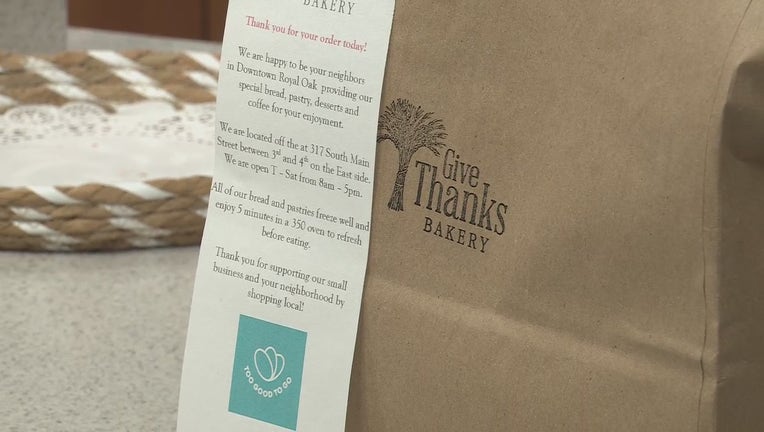
a Too Good To Go bag from Give Thanks Bakery

Americans waste a lot of food, but an app that recently expanded to Metro Detroit is aiming to get that food on plates and out of landfills. The United States throws away approximately 120 billion pounds of food a year, according to Recycle Track Systems. The bulk of that waste comes from homes, followed closely by restaurants, grocery stores, and food service companies.

Too Good To Go partners with restaurants to help the eateries sell surplus food to customers at a discount. It’s pretty simple – the restaurants list surprise bags on the app that customers can claim for a small fee and pick up during a specified time. The app is open to restaurants, grocery stores, and food suppliers. Currently, nearly 80 Metro Detroit businesses have signed up for Too Good to Go.

Surprise bags in Metro Detroit typically range from $3.99 to $6.99, and could contain anything from entrees and baked goods to ingredients used at the restaurant. Customers can expect to pay about ⅓ of what the items would have cost at full price. Baked goods are the most popular category of leftover food, but any unsold food item could end up in your bag.

“It’s really fun for the customer,” said Too Good to Go spokesperson Sarah Soteroff, referring to the surprise that comes with each bag. She said the variety “reflects the unpredictability of food waste.” Since the Detroit launch, the app is now also open to restaurants statewide.

According to the Michigan Sustainable Business Forum, food is the most prominent waste in the state’s landfills. That waste is bad for the environment, the economy, and people in need. Food waste is responsible for 10% of greenhouse gas emissions worldwide. Additionally, about 25% worth of freshwater is used annually to produce food that gets wasted. These food losses amount to around $1.1 trillion lost annually. Beyond the environmental and economic issues, this food is going to waste while millions of people go hungry.

Too Good To Go got its start in Coppenhagen in 2016. It then launched in the U.S. in 2020, and it is now active in 30 cities across 17 states. Soteroff said the app has helped save about 330 million meals worldwide, with 12 million saved in the U.S. alone. According to Soteroff, since Too Good To Go expanded to Michigan, around 3,200 meals that otherwise would have ended up in the trash have been saved.

Beyond keeping food out of the trash, Soteroff said using the app helps both participating businesses and customers financially. Participating businesses are charged a small fee to use the app. Through the app, Soteroff said these businesses have been able to earn an estimated $39 million from food sold through the app that otherwise would have ended up in a dumpster. Meanwhile, she said customers have saved about $120 million by purchasing discounted food through the app. Once you make your first Too Good To Go purchase, the app tells you how much you’ve saved compared to retail price.

 “imagine walking out of a grocery store with four bags of groceries, dropping one in the parking lot,

and just not bothering to pick it up. that’s essentially what we’re doing.”

– Dana Gunders, Food & Agriculture Scientist with the Natural Resources Defense Council.


souce credits: amber ainsworth, fox 2 news, recycle track systems

*good planets.

Standard

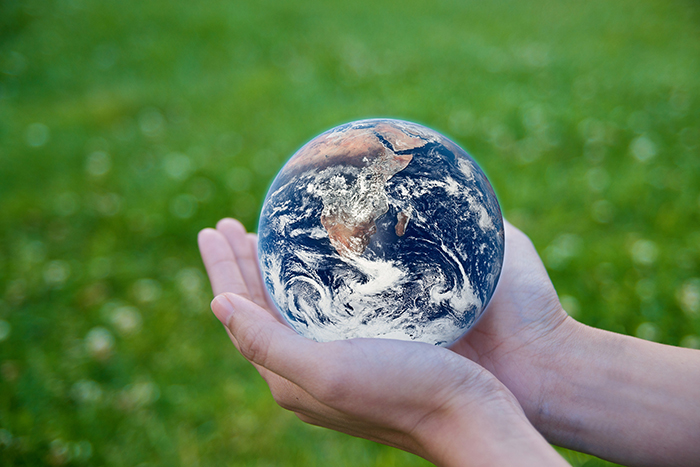
good planets are hard to find


on earth day 2023

photo credit: earthtalk

Reply

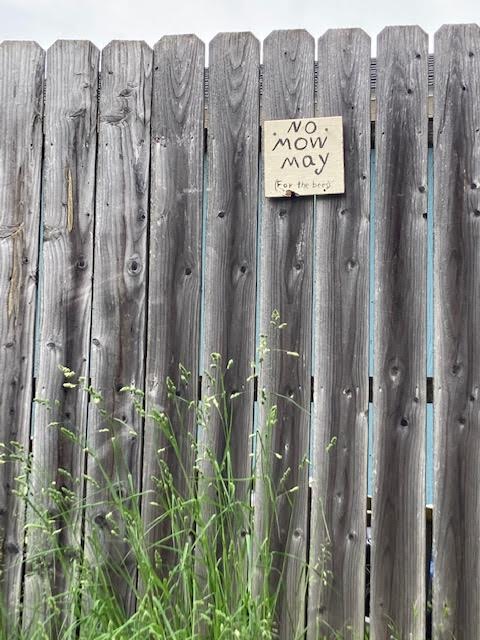
“no mow,” said the bee.

Standard

bee kind

“for this,
let gardens grow, where beelines end,
sighing in roses, saffron blooms, buddleia;
where bees pray on their knees, sing, praise
in pear trees, plum trees; bees
are the batteries of orchards, gardens, guard them.”
Carol Ann Duffy, The Bees

something to crow about.

Standard

Crows help rid city streets of cigarette butts

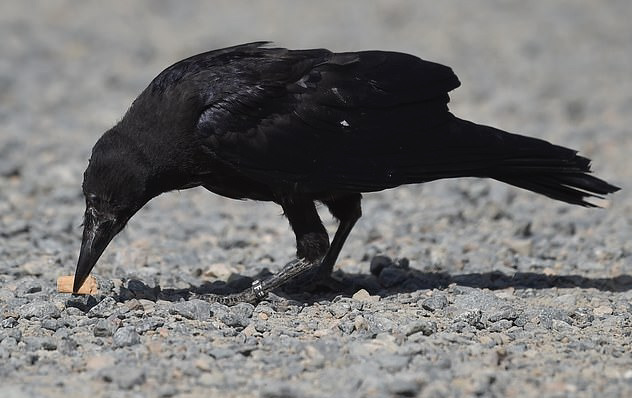
A startup in the Swedish city of Södertälje, has recruited local crows to pick up discarded cigarette butts from the city’s streets and public spaces. In fact, there’s a movement afoot in places as varied as California and the Netherlands to ban the sale of filtered cigarettes to help tamp down on their prevalence in our environment.

According to the Keep Sweden Tidy Foundation, more than one billion cigarette butts are left on Sweden’s streets each year, which represents 62 percent of all litter. To clear the streets, Södertälje spends around 20m Swedish kronor (over $2,200,000), so the hope is that the birds can help cut these costs.

“They are wild birds taking part on a voluntary basis,” the founder of the Corvid Cleaning startup Christian Günther-Hanssen reveals. Each time the wild birds deposit a cigarette butt into a bespoke machine specially designed by Corvid Cleaning, they receive a little snack.

Günther-Hanssen estimates that, with the crows’ help, the city could save at least 75 percent of the costs associated with picking up cigarette butts in the city. For now, Södertälje is trialing the project before setting the operation in motion across the city, paying close attention to the health of the birds, considering the kind of waste they’re being rewarded to pick up.

Research suggests that New Caledonian crows, a member of the corvid family of birds, have the reasoning ability of a human seven-year-old, making them the best bird for the job. “They are easier to teach and there is also a higher chance of them learning from each other,” says Günther-Hanssen. “At the same time, there’s a lower risk of them mistakenly eating any rubbish.” Unfortunately, they have not yet been able to train humans not to throw their butts on the ground. 

“if men had wings and bore black feathers, few of them would be clever enough to be crows.”

-henry ward beecher

piaget. (repost-computer still in flux)

Standard

*Jean Piaget (1896-1980) in his office.

Shout out to all those who didn’t tidy their office before the start of the school year.

“simple solutions seldom are. it takes a very unusual mind to undertake analysis of the obvious.”

-alfred north whitehead

*Piaget’s (1936) theory of cognitive development explains how a child constructs a mental model of the world. He disagreed with the idea that intelligence was a fixed trait, and regarded cognitive development as a process which occurs due to biological maturation and interaction with the environment.

credit: modern language association

hidden life radio.

Standard

listen….

Silent tree activity, like photosynthesis and the absorption and evaporation of water, produces a small voltage in the leaves. In a bid to encourage people to think more carefully about their local tree canopy, sound designer and musician Skooby Laposky has found a way to convert that tree activity into music.

By connecting a solar-powered sensor to the leaves of three local trees in Cambridge, Massachusetts, Laposky was able to measure the micro voltage of all that invisible tree activity, assign a key and note range to the changes in that electric activity, and essentially turn the tree’s everyday biological processes into an ethereal piece of ambient music.

You can check out the tree music yourself by listening to the Hidden Life Radio—Laposky’s art project—which aims to increase awareness of trees in Cambridge, Massachusetts, and the city’s disappearing canopy by creating a musical “voice” for the trees.

The project features the musical sounds of three Cambridge trees: a honey locust, a red oak, and an 80-year-old copper beech tree, all located outside the Cambridge Public Library. Each tree has a solar-powered biodata sonification kit installed on one of its branches that measures the tree’s hidden activities and translates it into music.

According to WBUR, between 2009 and 2014, Cambridge was losing about 16.4 acres of canopy annually, which is a huge loss considering that tree canopies are crucial to cities,  cooling them down during the summer, reducing air pollutino, sucking up carbon, and providing mental health benefits.

Laposky hopes that people will tune into Hidden Life Radio and spend time listening to the trees whose music occurs in real-time and is affected by the weather. Some days they might be silent, especially when it hasn’t rained for several days and they’re dehydrated. The project will end in November, when the leaves will drop — a “natural cycle for the project to end,” Laposky says, “when there aren’t any leaves to connect to anymore.”


 “in a cool solitude of trees

where leaves and birds a music spin,

mind that was weary is at ease,

new rhythms in the soul begin.”

-william kean seymour

source credits: Kristin Toussaint, The Optimist Daily, WBUR Radio

nature or nurture?

Standard


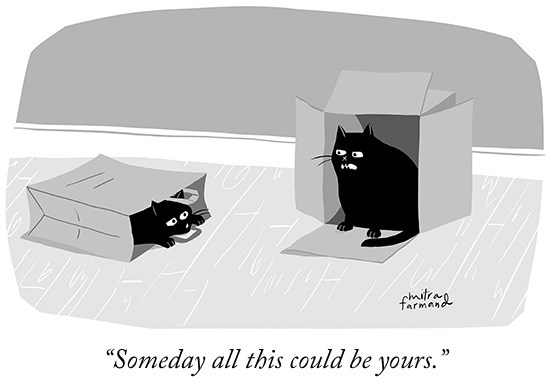
“You inherit your environment just as much as your genes.”

Johnny Rich, The Human Script


cartoon credit: Mitra Farman,The New Yorker

origami and chocolate.

Standard

it’s important we each do our part to help Mother Earth

and here is a way we can all pitch in,

with two of my favorite things on this earth,

paper and chocolate.

you are welcome.

Japanese KitKats Are Replacing Plastic Packaging

with Origami Paper You Can Turn into Cranes!

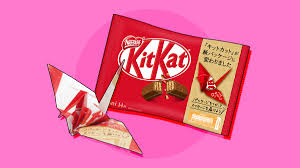
From plant-based, bio-plastic Lego to Adidas’s first fully recyclable running shoe, companies worldwide are working hard to make their products and packaging more sustainable. Last year, food and drink manufacturer Nestle announced that it plans to use 100% recyclable packaging for its products by 2025. As part of that goal, nestle Japan recently released new packaging for its popular miniature KitKat chocolate bars, which will now be wrapped in origami paper instead of plastic.

“Plastic waste is one of the biggest sustainability issues the world is facing today,” Nestlé CEO Mark Schneider says “Tackling it requires a collective approach. We are committed to finding improved solutions to reduce, re-use and recycle.” Japan is the biggest market for KitKats, with 4 million being sold every day. By swapping out the candy bar’s shiny plastic wrap for eco-friendly matte paper, Nestlé expects to cut down on roughly 380 tons of plastic each year.

The new packaging is not only good for the environment, but it’s fun too! Each KitKat bar will include instructions on how to fold a traditional origami crane—a symbol of hope and healing. Customers are encouraged to turn their trash into art, with the hope that the paper will remain in use for longer.

The environmentally-friendly packaging debuts with the most popular KitKat Mini flavors—original, matcha, and dark chocolate—but the positive change is just the beginning. Next year, Nestlé Japan plans to release paper bags for its normal-sized KitKat multipacks, and will roll out single-layer paper wrappers for individual KitKats in 2021.

“the visionary starts with a clean sheet of paper, and re-imagines the world.”

-malcolm gladwell


credits: mymodernmet.com, atlas obscure, emma taggart, nestles japan


why not do it?

Standard

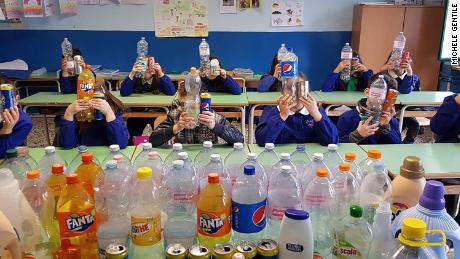
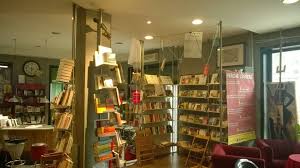
Children at San Rufo elementary school in Salerno, southern Italy, are swapping plastic for books. A bookseller/cafe owner in southern Italy is offering free books to schoolchildren who bring him one plastic bottle and one aluminum can to recycle. Michele Gentile, who founded the Ex Libris Cafe bookshop in Polla, a small town near Salerno, said he wants to encourage kids to read while doing something for the environment.

“My goal is to spread the passion and love for books among those people in Italy who do not usually read, while at the time helping the environment,” he said. “I hope the initiative becomes so viral that it affects the whole country. It will be revolutionary, not only for the planet but also for the education of children and their job prospects,” he said.

The books being donated for the initiative are the so-called “pending” or “suspended” books (“libri sospesi” in Italian), a concept introduced by Gentile a few years ago that earned him headlines in national media. The term derives from the “suspended coffee” Neapolitan tradition, born during World War II, of purchasing two coffees: one for yourself and the second one as an anonymous gift for the next customer in need who walks into the bar. Similarly, Ex Libris customers can buy one book and leave the second one “suspended” for whomever needs it.

The idea for the “plastic/metal for books” recycling initiative came to Gentile while he was looking at a huge pile of metallic waste left abandoned on a field. “It was worth at least 300-400 euros ($338-$451), enough to pay for a middle school kid’s book allowance for a year,” he said. “So, I talked to a local school, and they organized an aluminum collection. Results were extraordinary, about 2 quintals ($564) in two days.” With the money he got from the recycling center, Gentile bought books for a whole class. “So, I thought: Why not (give) away books to kids who bring me plastic bottles and cans?” he said.

His initiative, which involves individuals and schools, has already reached northern Italy, with children from Bordighera, in the Liguria region, sending him 23 bottles and 23 cans to recycle. “Yesterday alone, I donated 60 suspended books,” Gentile said. “Imagine if this becomes a small game: Every child in the world swaps a plastic bottle and a can for books. I know it’s just a dream, but why not do it?

“it takes generosity to discover the whole through others.

If you realize you are only a violin,

you can open yourself up to the world by playing your role in the concert.”

-jacques yves cousteau


credits: cnn world news, gianluca mezzofiore