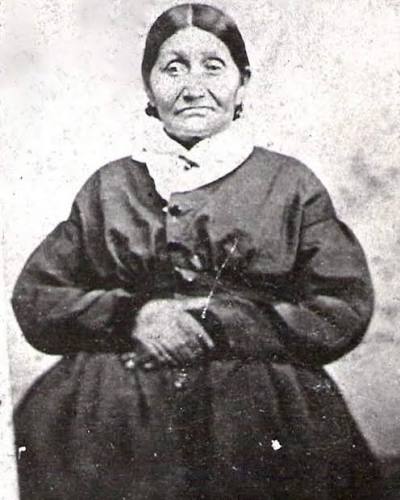
Jane Johnston Schoolcraft, (1800-18 42) also called Bamewawagezhikaquay (“Woman of the Sound the Stars Make Rushing Through the Sky”), was the daughter of an Ojibwe woman and an Irish settler. She was lived most of her life in the settlement of Sault Ste. Marie on lands that are now part of the state of Michigan. Jane was part of the extended community of mixed race men and women who acted as social and cultural bridges between Indigenous communities and white settlers in the Great Lakes region. Jane married Indian Agent and ethnographer Henry Rowe Schoolcraft in 1823. As the wife of an Indian Agent, Jane saw firsthand how the U.S. government was dispossessing Indigenous communities throughout the country.
Jane was a talented writer who wrote about 50 poems in both Ojibwe and English, making her the first known Indigenous woman writer in North America. She may be the first Indigenous literary writer of any gender. Her English translations of Ojibwe oral histories and songs formed the backbone of her husband’s work. They were also the main source for Henry Wadsworth Longfellow’s famous epic poem The Song of Hiawatha.
“Lines Written at Castle Island, Lake Superior,”
Jane Johnston Schoolcraft, Michigan, 1838.
Here in my native inland sea
From pain and sickness would I flee
And from its shores and island bright
Gather a store of sweet delight.
Lone island of the saltless sea!
How wide, how sweet, how fresh and free
How all transporting —is the view
Of rocks and skies and waters blue
Uniting, as a song’s sweet strains
To tell, here nature only reigns.
Ah, nature! here forever sway
Far from the haunts of men away
For here, there are no sordid fears,
No crimes, no misery, no tears
No pride of wealth; the heart to fill,
No laws to try my people ill.
Discover more from I didn't have my glasses on....
Subscribe to get the latest posts sent to your email.


Her name is a poem. Thank you for sharing, Beth!
LikeLike
So interesting, a fascinating piece of writing!
LikeLike
Fascinating Beth.
Thank you for sharing.
LikeLike
Such a very fascinating story, Beth, but how painful it must often have been to be caught between two cultures, especially when one of them was mostly intent on control and worse.
LikeLiked by 1 person
yes, luckily her husband was progressive
LikeLike
Indeed, yes.
LikeLiked by 1 person
I love her name (the native one).
LikeLiked by 1 person
it is so wonderful
LikeLike
My father’s mother was an Irish Canadian who married a grandson of the Chief of the Ottawa Indians, in Quebec. They attempted to live here in Michigan for a while, and several of their children were born here, but my grandfather returned to his tribe’s land, abandoning the family here. It was a very hard life for him here. AS I was reading this poem, it made me think of the grandparents I never knew and perhaps, help e understand them a bit better.
LikeLiked by 1 person
What a fascinating history, in your own family. It must’ve been very hard.
LikeLiked by 1 person
That’s really interesting, Beth.
LikeLiked by 1 person
so much of the indigenous history has been lost or outright destroyed, I’m glad this poem survived. Thanks for sharing.
LikeLiked by 1 person
You are so bright. It was my pleasure to share it and I am also glad it survived
LikeLike
You find interesting stuff.
LikeLiked by 1 person
Sometimes, it finds me.
LikeLiked by 1 person
What a wondrous woman. So much to look up to 💗
LikeLiked by 1 person
Yes, I so admire her.
LikeLiked by 1 person
So lovely to read about her, and so lovely for you to make us aware of her. 🌿🌺
LikeLiked by 1 person
This is just a tiny bit of her fascinating history, and happy to share this.
LikeLiked by 1 person
Her Ojibwe name is a poem in itself. And her poem is both beautiful and heartbreaking.
LikeLiked by 1 person
I felt exactly the same about both of those elements.
LikeLike
This is so interesting, especially since I only know of Henry Schoolcraft, credited with discovering the source of the Mississippi in northern Minnesota.
LikeLiked by 1 person
The two of them have absolutely fascinating histories. This is just the tip of the iceberg.
LikeLike
I love histories like this.
LikeLiked by 1 person
I do as well and there is so much more to our history. This is just the tip of the iceberg. She was an absolutely fascinating person.
LikeLiked by 1 person
Wonderful poem! Thank you for sharing her history.
LikeLiked by 1 person
It was my pleasure, Edward.
LikeLiked by 1 person
What a beautiful name and a lovely poem! My Native American ancestor from the Montauk tribe married an Englishman who served as a translator. She died of smallpox.
LikeLiked by 1 person
I agree about her name in the poem. She died when she was 42 years old, so maybe that was the cause of her death as well. So tragic such losses.
LikeLike
What an amazing woman. Thank you so much for bringing her to our attention.
LikeLiked by 1 person
there is so much more to her story, she was absolutely amazing!
LikeLike
Thank you so much, Beth! I love hearing some of her poetry and her name is just gorgeous.
LikeLiked by 1 person
yes, to both
LikeLike
Fascinating stuff
LikeLiked by 1 person
she really has an interesting story
LikeLike
Quite interesting!
LikeLiked by 1 person
What a beautiful name and an amazing woman. Thank you for sharing, beth.
LikeLike