At This Once-Secret Exhibition, the Met’s Security Guards and Staff Display Their Own Art
For the first time since 1935, the show is finally open to the public
More than 450 pieces made by Met staff members are on display in this year’s exhibition. Photo by Eileen Travell / Courtesy of the Metropolitan Museum of Art
Every two years, staff members at New York City’s Metropolitan Museum of Art get the chance to display their own creations on the institution’s hallowed walls. Since the tradition started in 1935, the exhibition has been something of a secret, open only to employees and their guests, Hyperallergenic’s Elaine Velie reports. But now, for the first time, the show is open to the public.
“Art Work: Artists Working at the Met” features hundreds of pieces—including paintings, drawings, photographs, sculptures and digital installations—made by guards, librarians, conservators, educators, registrars and others who work at the Manhattan museum. More than 450 of the Met’s 1,700 employees contributed to the exhibition, which is held in the space next to the museum’s ancient Greek sculpture hall, Hyperallergic notes. The show accepts all staff-made submissions, which are installed by Met staff members working extra hours.
Daniel Kershaw, a Met exhibition design manager who has overseen the show’s curation for more than two decades, says he identifies themes that unify the disparate submissions, grouping pieces that work well together (for example, landscapes go next to other landscapes). This year’s show includes a photograph of Cuba, an oil painting of a partially frozen pond, a series on Black life in Brooklyn’s Crown Heights neighborhood, and jars and cans painted to look like tiny monsters, among other works.
Until this year, museum officials and employees were extremely furtive about the exhibition—so much so that the New York Times’ Corey Kilgannon struggled to find sources for a 2012 story on the show. When he visited the Met and asked guards about it, they told him they were forbidden to discuss it with the press.
After some more digging, Kilgannon found a few guards willing to talk, including Peter J. Hoffmeister, who expressed concerns about the secrecy around the event. “It’s complicated to have artists working for you who want their art on the walls—I understand that,” Hoffmeister told the Times. “But as an artist I think it should be public, because keeping it private defeats the purpose of having an art show.”
Some of the Met’s employees are artists who work at the museum to supplement their income, while others make art as a hobby, according to Hyperallergic. But everyone who submits to the show is balancing their art with their day jobs.
Back in 2012, one such individual was Christoper Boynton, a painter, photographer and museum guard. At the time, Boynton didn’t know why the show was closed to the public. “Maybe it’s because they would have to insure the art in the show,” he told the Times. “Maybe it’s that, if someone’s artwork is shown at the museum, people may think it’s being sanctioned by the museum.”
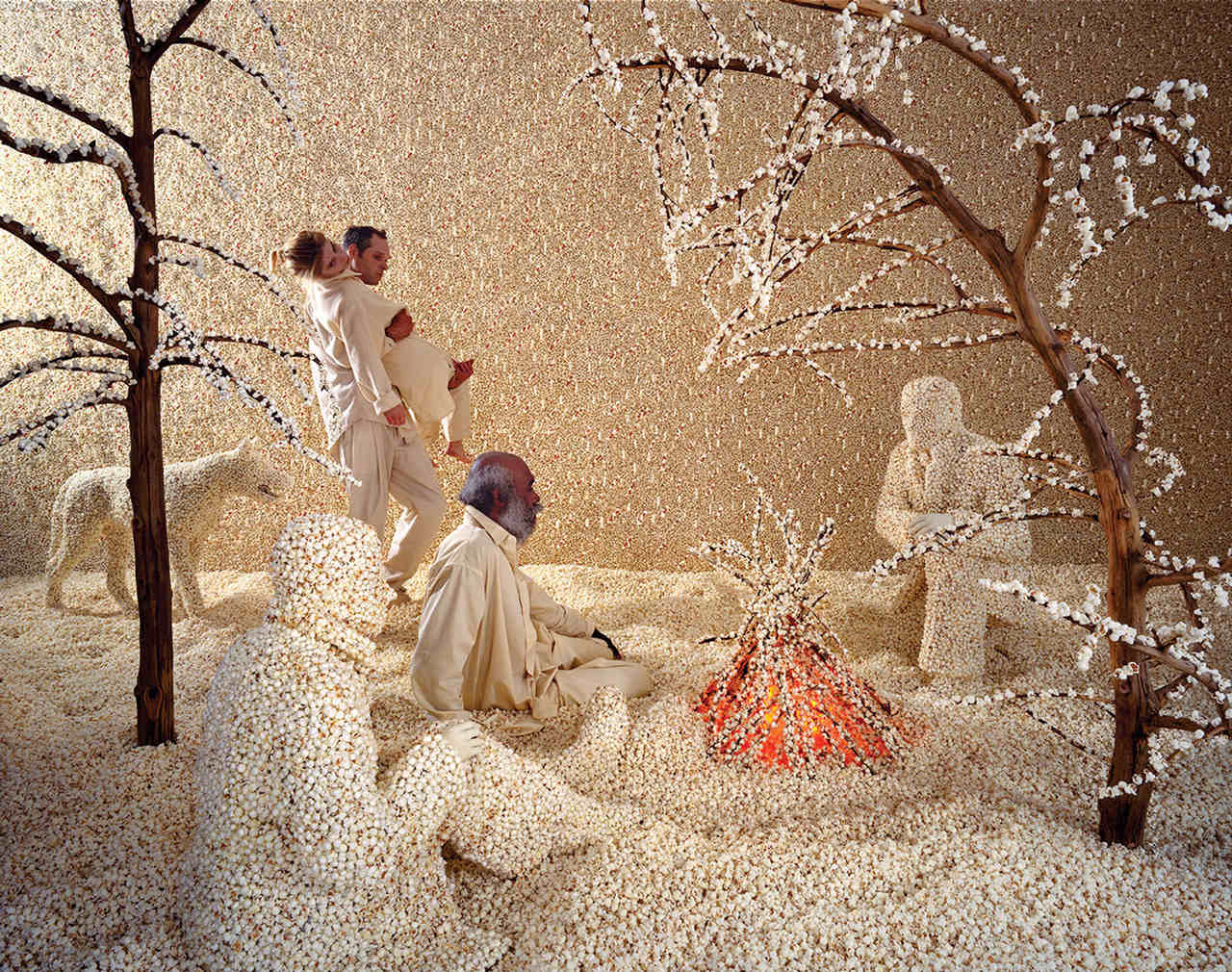
Raining Popcorn (2001) is a piece commissioned by the Faulconer Gallery of the Grinnell College in Iowa. The commission would take artist, Sandy Skoglund many months to complete. In Skoglund’s art practice, the conceptual subject matter works in conjunction with the physical materials she uses, drawing on historical references, and instilling them with psychologically complex meaning.
Produced in 2001, just before the September 11 attacks, Raining Popcorn references the complex roots of American contemporary culture and overconsumption. The unifying subject throughout the piece is popcorn, so pronounced and repetitive it replaces nature. The popcorn becomes an all-encompassing reality, lining the walls, the floors, the subjects, and alas growing from trees. This obsessive environment constructed by Skoglund derives from the artist’s desire to combine sculptures of animals, live humans, and nature into a space that involves thought and play, as part research and part recreation.
The abundance of Popcorn acts as a reflection of the cultural environment, being noisy, excessive, universal, and part of popular culture. Currently, Americans eat 13 billion quarts of Popcorn a year, produced mostly in the heartland of America, from Illinois to Ohio. The piece is a response to memories and experiences Skoglund felt as a graduate student in Iowa.
The painstakingly handcrafted quality of the endless popcorn creates a fantasy landscape, one that raises questions about climate issues and our surrounding environment, as well as fantasy and reality. In Raining Popcorn, Skoglund’s objects and composite staging have a base in truth; they are not a product of photoshop or digital manipulation. It is critical for the artist that the photographs evidence something genuine. The constructions are explicitly staged to be photographed from one unique viewpoint.
—
“americans love popcorn, and their love doesn’t quit.”

:focal(4096x2731:4097x2732)/https://tf-cmsv2-smithsonianmag-media.s3.amazonaws.com/filer_public/a2/08/a208b836-e73e-4a7c-b63c-4d7a1b9f1ecd/76a5151.jpg)



 I didn't have my glasses on....