Inuit in Canada’s North have their own unique names for the months of the year. Aseena Mablick, an announcer for CBC Nunavut’s Inuktitut-language radio program Tausunni, has been collecting information on the names of the months in Inuktitut for years.
Mablick says one of the reasons she’s sharing this now is to “keep the language.”The names in Inuktitut are interconnected with the environment and wildlife surrounding the Inuit in Canada’s North.”It’s a truthful and honest calendar for people who are living over here, everyday, like us,” she says. “We just follow mother nature’s ways for naming the calendar.”
Each region in Nunavut has its own unique names for the calendar, and Mablick shared with us just two of the regions she’s looked into — Baffin region (also known as the Qikiqtaaluk Region) and Nunavik (northern Quebec).
January In Nunavik, January is “Naliqqaittuq”, literally meaning “nobody’s able to compete with it,” says Mablick. “It has to do with the coldest weather in that month.”
January is called “Qaummagiaq” in the Baffin region. It means “bright day coming back.”
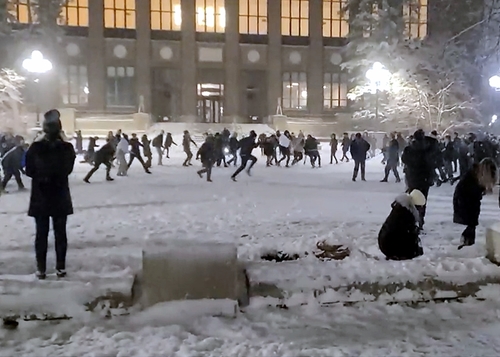
meanwhile in ann arbor…
Continuing a six-decade tradition,
hundreds participated in a huge snowball fight
at the University of Michigan Diag,
embracing the Michigan snowstorm.
==
credits: cbc news (north), aseena mablick, deadline detroit
Press night performance of Grease at London’s Dominion Theatre
A new program in London will soon start giving away unsold theater tickets to those who couldn’t otherwise afford them. Called the Ticket Bank, it will aim to dole out 1,000 tickets per week to theater, dance, music and comedy shows. The tickets will be free or pay-what-you-can.
The Ticket Bank is an arts-oriented variation on a food bank: giving donations, or any available surplus, to those in need. The pilot program will launch on January 9, 2023 and run for one year.
Report an ad
“There are brilliant people putting together food banks and heat banks, but that doesn’t give humanity its basic needs from a soul point of view,” Chris Sonnex, who conceived of the idea, tells the Guardian’s Harriet Sherwood. “People who are suffering as a result of the cost of living also need access to community, entertainment and things that warm the soul.” Sonnex is the artistic director at Cardboard Citizens, a performing arts organization for people with the experience of homelessness. “Art,” he tells the Guardian, “is a human right.”
The initiative is focused on the skyrocketing cost of living, which puts cultural experiences out of reach for more and more people—especially in major cities like London. But it also aims to help cultural institutions like theaters, which have seen dwindling audiences due to economic crises and pandemic restrictions.
London isn’t the first city to launch a unique program to reinvigorate interest and participation in the arts. Several other cities, including Quebec and Brussels, have opened up their museums for free mental health visits in recent years. Twice yearly, during New York City’s Broadway Week, popular shows offer tickets at a majorly discounted rate.
Report an ad
Sonnex enlisted the Cultural Philanthropy Foundation, an organization aiming to “democratize access to culture,“ to help make the project happen. “Very rarely do you come across an idea that is so simple and brilliant that you can’t believe it doesn’t already exist,” Caroline McCormick, the foundation’s chair, says. “When Chris Sonnex told me his idea for the Ticket Bank, my response was as simple as his idea. ‘We have to make this happen.’”
Seven theaters have agreed to participate in the imitative: the National Theater, the Roundhouse, the Barbican, the Almeida, Gate, Bush and Tara theatres. Another seven will be announced in January.
“Everybody’s seen the value, everyone wants to make it work,” McCormick tells BBC News.
A group of London and UK-based partners will ensure the tickets reach people and communities in need or historically underserved by cultural organizations.
Report an ad
While “a million different barriers” make accessing the arts difficult, “one of the biggest is ticket prices,” Sonnex tells the Guardian. “It’s important to reach as many people as possible to say: This is for you.”
—
“i believe in the healing power of the arts,
and whenever you can bring art into anyone’s life, it’s a special thing.”
-austin nichols
—
credits: smithsonian magazine, molly enking, getty images, david m. bennett, the guardian, harriet sherwood, bbc news, the ticket bank
“You’ve got to know when to hold ’em Know when to fold ’em Know when to walk away And know when to run You never count your money When you’re sittin’ at the table There’ll be time enough for countin’ When the dealin’s done.”
This 19th-century warm, hearty, and festive cocktail still fights cold nights in the Midwest.
IT’S NOT OFTEN ONE NEEDS to make a batter for a cocktail, but so it is with the Tom and Jerry, a Christmas party staple in the American Midwest. The drink begins with a frothy batter of separately beaten egg whites and yolks folded together and mixed with sugar and warm spices. When served as a party punch, the batter is often ladled out of special Tom and Jerry punch bowls into matching cocktail mugs, along with hot milk (or water), rum (or brandy), and a sprinkle of nutmeg. The result is a delicious, warm revamp of the classic eggnog.
The Tom and Jerry’s origins are frequently traced back to a publicity stunt orchestrated by British journalist, Pierce Egan. The story goes that he added brandy to eggnog to create a signature cocktail to promote his 1821 book, Life in London. A subsequent play based on the book, Tom and Jerry, or Life in London, has additionally been associated with the beverage. While this remains unverified, Egan’s work did make a meaningful contribution to the drinking world: the phrase “Tom and Jerrying” which means indulging in loud, drunken behavior.
No definitive records exist about the drink’s first appearance stateside, but in 1862, the famed New York bartender Jerry Thomas published a recipe for a Tom and Jerry in his book, “How to Mix Drinks, Or, The Bon-viant’s Companion.” (great title)
Historians are unclear as to why the Tom and Jerry became such a Christmas staple in the Midwestern United States, but it was popular enough to merit a cottage industry of Tom and Jerry drink sets, consisting of punch bowls and mugs inscribed with the drink’s name in Old English font. Milk glass Tom and Jerry sets were fairly common in the 1940s through the 60s. A New York Times article about the cocktail quotes author Jim Draeger, who surmised that the Tom and Jerry became a Wisconsin staple because the state has an affinity for brandy drinks, and is also a dairy state. Perhaps more than anything, the intense cold of the American Midwest has arguably solidified this warming drink’s staying power in the winter drinking traditions of the region.
Ingredients
6 eggs
1/8 teaspoon cream of tartar
1/2 ounce Jamaica rum
¾ teaspoon of ground cinnamon
¼ teaspoon ground cloves
¼ teaspoon ground allspice
½ cup sugar
Brandy or rum
Boiling water or hot milk
Grated nutmeg, to garnish
Instructions
Separate the eggs. Beat the whites with cream of tartar until they form stiff peaks, then beat the yolks until they are, according to Thomas, “thin as water.”
Add the spices and rum to the yolks, and continue stirring until incorporated. Fold the egg whites into the yolk mixture.
Thicken the mixture with sugar until it has the consistency of a light batter.
Serve in standard coffee mugs. In each mug, mix two tablespoons of the batter with three tablespoons of brandy or rum. Top off with milk or water, or a combination of the two. Grate fresh nutmeg over the surface and serve.
note: we are currently dealing with blustery winds, blowing snow, white-outs, and single-digit – below zero temps, and i have always lived in the midwest (in michigan), but have never encountered or heard of this drink. any readers out there ever had this?
—
“heap on more wood – the wind is chill;
but let it whistle as it will,
we’ll keep our christmas merry still.”
-sir walter scott
—
source credits: gastro obscura: rohini chaki, photo-sam o’brien, nyt