Tag Archives: art

museum.

Standard

curbside museum

a small and quirky museum hidden is inside a fence

in canmore, alberta, canada

curbside museum is an unassuming curiosity in the mountain town of canmore, canada. the tiny museum is always packed with intricate little exhibits that rotate every so often. each exhibit is incredibly detailed, their contents all stuffing the glass showcase to the brim with a delightfully unexpected assortment of items.

this tiny museum is hidden within a hole in a fence that lines a busy street. the gilded frame is the only hint that this particular stretch of fence holds more than first meets the eye. you could easily walk right past it if you weren’t paying attention.

you’ll find subjects ranging from common scenes to those that transcend into the realm of fantasy. some of the showcases take on a more serious, factual tone, though many exhibits do indeed have an element of whimsy and charm.

the museum is a fun addition to the town and adds a moment of joy for any pedestrians who stop and take a peek. it’s a reward for eagled-eyed passersby who take the time to notice their surroundings. the museum is free and is open day and night.

“a museum should not just be a place for fancy paintings

but should be a place where we can

communicate our lives through our everyday objects.”

-orhan pamuk


—

credits:  curbside museum, atlas obscura.com, city of canmore, alberta

hands.

Standard

kinders experience the world hands-on.

—
“the final forming of a person’s character lies in their own hands.”

-anne frank

heart.

Standard

“write it on your heart that every day is the best day in the year.”

-ralph waldo emerson

happy valentine’s day


—
-‘dried reeds’ created by roadsworth, montreal, canada

february arrives.

Standard

“february, a form
 pale-vestured, wildly fair,


one of the north wind’s daughters,
with icicles in her hair.


~Edgar Fawcett, “The Masque of Months,” -1878


—

image credits: teodora paintings
, magic onions

glitt-her.

Standard

(yet another underpaid re-enactor)

when at the salon recently

my stylist was combing out my hair and asked:

“why do you have glitter in your hair?”

now, there are many possible scenarios

some more accepted than others

but i suppose in my case

it most likely has to do with

my being

a kindy teacher

a creator of mixed-media collage art

and

a fan of glitter

and i see

that a pattern

has begun to emerge

when family and friends and colleagues

and even my cat

quite often have glitter on them

after spending time with me

and my grandson mentions

that he always finds glitter stuck to him

after we’ve been hanging out together

and people sometimes

brush glitter off of their legs

after getting out of my car

but

some people leave footprints

and

some people leave glitter

and that’s how you know

they’ve been there.

—

“when you’re around me, you’re going to get glitter on you.”

-kesha


—

photo credits: fx hair studio, all things hair

eat like a genius.

Standard

The Grocery List Sketched by Michelangelo
You can’t sculpt like Michelangelo, but you can eat like him.

In March 1518, Michelangelo feasted on fish and bread. 

ACCORDING TO MICHELANGELO’S SHOPPING LIST, genius thrives on a diet of fish, bread, and lots of wine.

Owned by the Casa Buonarroti museum in Florence, Italy, this 500-year-old list was written and illustrated by the sculptor/painter/poet/personality on the back of a letter. Michelangelo’s servant was likely illiterate, so Michelangelo sketched out what he wanted to eat.

And Michelangelo wanted a feast, spread out over three meals. He depicted bread rolls as quickly-drawn circles, and for one meal, Michelangelo wanted two rolls. For another, he wanted six. On the page, an elegant herring floats in the air, while bowls overflow with salad and anchovies. Two dishes of stewed fennel are sketched side by side, and when asking for a smaller amount of dry wine, Michelangelo carefully drew a small wine jug next to a larger one. Sadly, he did not draw two plates of tortelli—he only asked for the ravioli-like pasta pouches in writing.

The menu consists mostly of vegetables, fish, wine, and bread. This might seem particularly healthy, but the letter on the other side of the list is dated March 18, 1518, around the time of Lent. Since eating meat was frowned upon, Michelangelo ate the requisite vegetables. However, Gillian Riley writes in The Oxford Guide to Italian Food that this was definitely an upscale menu. Despite his frugal reputation, the artist was probably used to dining with nobility.

By 1518, Michelangelo had already finished many of his most famous works, including the Pietà, the David, and the Sistine Chapel ceiling. But among all his work, this rough list is perhaps the most down-to-earth glimpse of the artist himself. It’s interesting to imagine the famously mercurial Michelangelo taking the time to illustrate for his servant what he wanted for dinner.

The survival of this list is remarkable, too. Only around 600 of Michelangelo’s sketches still exist. 1518 marked the year that Michelangelo burned many of his early drawings, and 46 years later, he ordered many of his papers to be torched in anticipation of his death. Maybe he wanted to preserve the aura of divine genius that surrounded his art. A list showing his sketched takeout order might not have given the right impression.


—

“all writing is an act of self-exploration.

even a grocery list says something about you;

how much more does a novel say?”

-steven saylor


—

credits: atlas obscura/gastro obscura, anne ewebank,Casa Buonarroti- Florence, Italy

science through coloring.

Standard

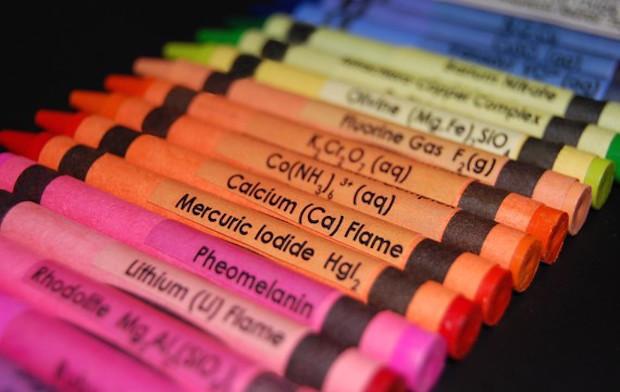
periodic table crayon covers teach kids science through coloring

one of the best ways to capture a child’s imagination is with a box of crayons. etsy shop ¡Que Interesante!, which calls itself a place “where geek meets art,” has created special labels for crayons and colored pencils to help kids learn about the elements of the periodic table, and their chemical reactions, while coloring.

¡Que Interesante! used the flame test, a qualitative test in which the chemical makeup of a compound is identified by the color it gives off when placed in a flame, to match chemicals to colors.

“so,” according to the company, “instead of thinking, ‘i want green’ they will think ‘i want Barium Nitrate Ba(NO3)2 Flame’ and then when they take chemistry in high school and their teacher sets some gas on fire and it makes a green color and they ask the class what chemical it was your student will know it was barium.”


—

“as long as chemistry is studied, there will be a periodic table.

and even if someday we communicate with another part of the universe,

we can be sure that one thing both cultures will have in common

is an ordered system of the elements that will be instantly recognizable

by both intelligent life forms.

—john emsley, nature’s building blocks: an A-Z guide to the elements


—

credits: etsy, mental floss, r.obias, que interesante

heart.

Standard

as seen on the lawn of the detroit institute of arts this morning


—

“there is no instinct like that of the heart.”

-lord byron


melt.

Standard

littlest hands

with

careful touch

make soft-rolled fluffy snowmen

 of whitest peppermint dough.

something’s lost

and

something’s gained

 each time someone new arrives

rising from the sparkly snow.

“we build statues out of snow, and weep to see them melt.”

-walter scott