—
credits: getty images, mentalfloss.com
—
credits: getty images, mentalfloss.com

“books give a soul to the universe, wings to the mind,
flight to the imagination, and life to everything.”
-plato
—
i stopped over to surprise
little grandie b
on her birthday
brought my gift
gave her a flower
shared a hug
then
she asked
if she could read to me
i had ‘read’ with her
just months before
when she pretended to read
a chapter book
imitating readers
she had seen and heard
excited to be like one of them
but today
she opened a book
read me every word
her little brother
said
“i don’t know how it happened.
but she can just read now.”
i told him
” it is magic.”
i was in awe of her
and
this surprise gift of magic
that she gave to me on her sixth birthday.
—
“once you learn to read, you will be forever free.”
– frederick douglass
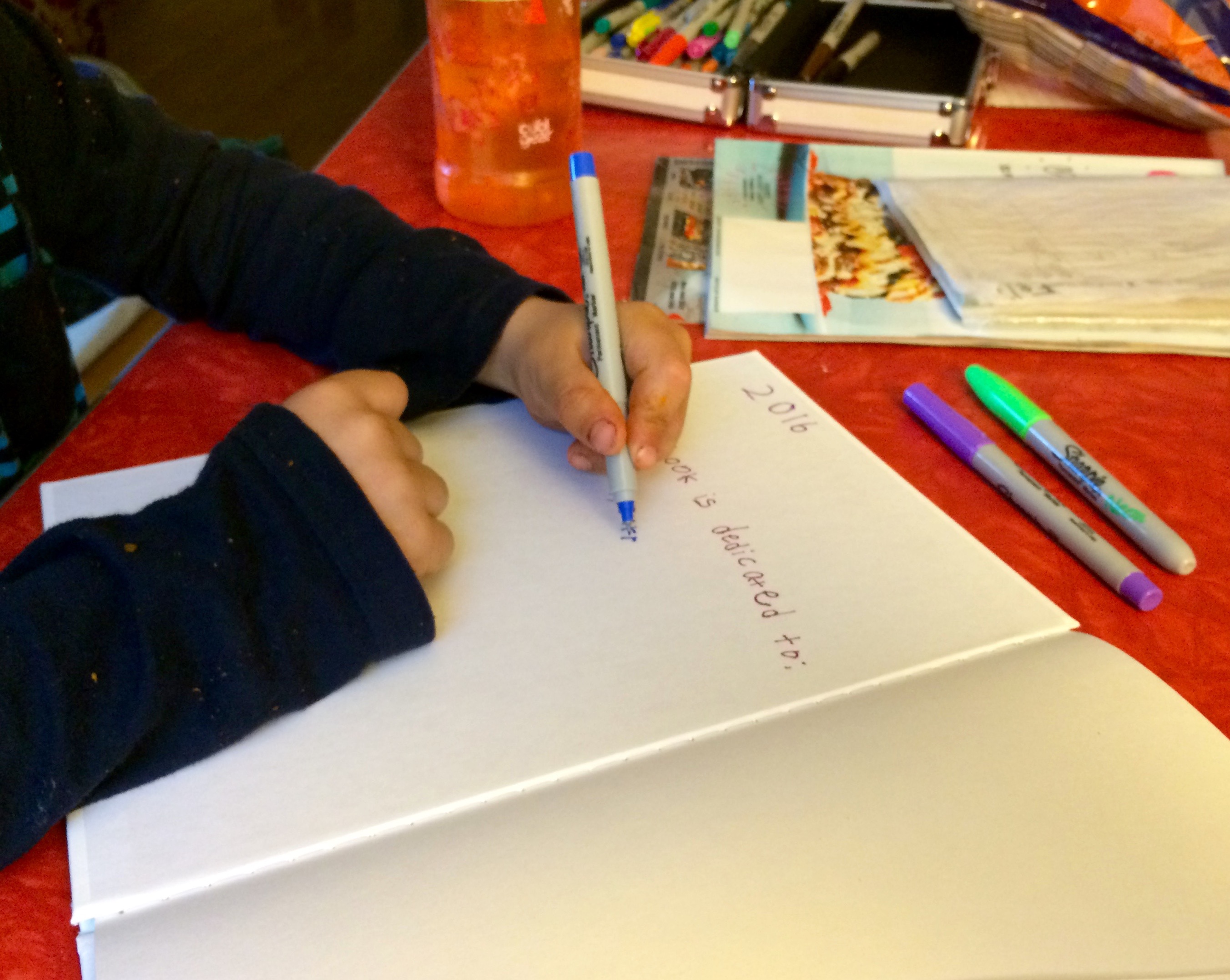
and
so it begins
writing a book with two of the grandies
we
have a story
and
have no idea
where it will go
the possibilities are endless
and
that is what makes it so exciting.
—
“writing is an exploration.
you start from nothing and learn as you go.”
-e. l. doctorow
—
image credit: grammarly
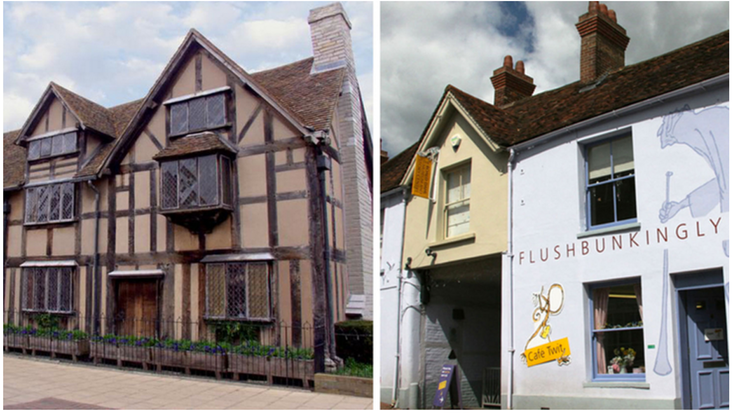
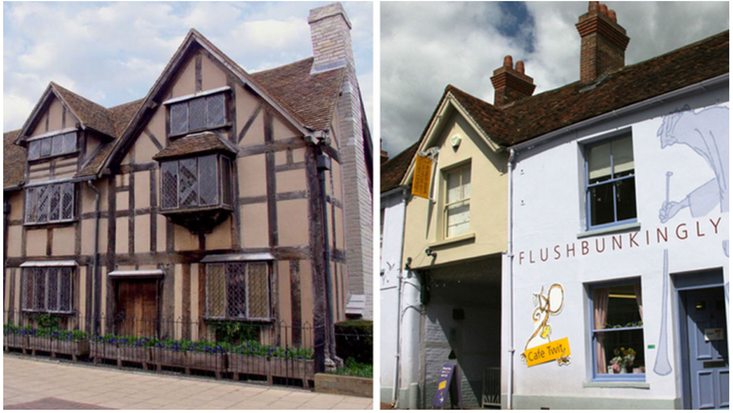
Shakespeare’s birthplace and The Roald Dahl Museum
You might think there’s nothing to link Roald Dahl and William Shakespeare, but there are a few things they have in common…
They’ve both got big anniversaries this year:
2016 marks 100 years since Roald Dahl’s birth, and 400 years since Shakespeare’s death. That means 2016 is a pretty great year for celebrating the lives and works of these two world-famous writers.
They both made up some crackling words:
Shakespeare coined countless new words and phrases, many of which have found their way into common usage, including ‘wild goose chase’, ‘laughing stock’, and ‘heart of gold’. Roald Dahl invented quite a few words of his own, especially while writing The BFG – who can forget snozzcumber, gigglehouse and exunkly?
Both authors have their very own dictionaries, both published by Oxford University Press. The Oxford Illustrated Shakespeare Dictionary and The Gobblefunk Dictionary (coming in June).
Quick quiz:
Can you tell which of the following 5 words are Roald Dahl words, and which 5 are Shakespeare words?
Babblement, Smilets, Bubukles, Crumpscoddle, Pulsidge,
Vizaments, Squizzled, Twangling, Bootboggler, Sossel.
(Answers at the bottom of the page!)
They both have links to the Royal Shakespeare Company:
Set up in 1875 the Royal Shakespeare Company was established to inspire a lifelong love of William Shakespeare and to produce new plays and productions. In 2010 the RSC’s production of Matilda the Musical based on Roald Dahl’s Matilda, premiered at The Courtyard Theatre in Stratford-upon-Avon, before moving to the West End in 2011. This record-breaking, award-winning musical is still going strong, made its way to Broadway in 2013 and toured Australia in 2015.
They are both loved worldwide:
Shakespeare is well and truly international. According to The British Council his works have been translated into over 100 languages (including Klingon), and performed worldwide – Romeo and Juliet has been performed in 24 countries in the last 10 years alone!
Roald Dahl books have been translated into 58 languages including Norwegian, Welsh and Japanese, but not Klingon… yet. During his lifetime Roald Dahl stuck a pin in a world map every time he received fan mail from a new place. Far flung destinations included Sao Paulo, Beijing, Addis Ababa and Windhoek.
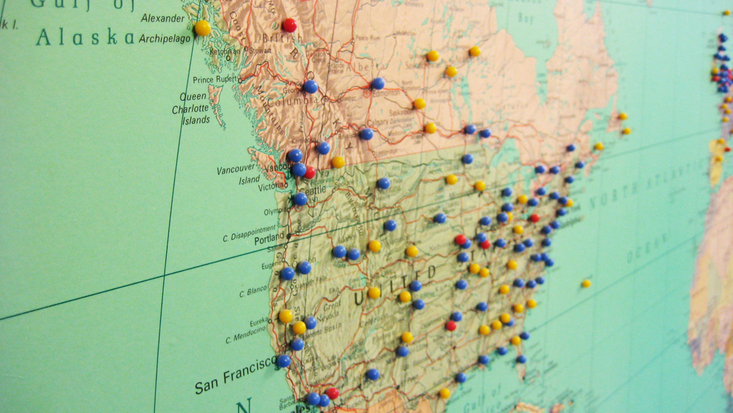
Roald’s Fan Map
They are both top ten borrowed authors:
Both Roald Dahl and Shakespeare are very popular with library goers it would seem. The Public Lending Right lists Roald Dahl as the number 1 most borrowed classic author in 2015, with Shakespeare taking tenth place. Not bad!
They’re big on the big screen:
Many of Shakespeare’s plays have been made into movies. According to the BFI the first Shakespeare film was made in 1899. Since then there have been countless film versions and adaptations including William Shakespeare’s Romeo + Juliet (1996), West Side Story (1961), and 10 Things I Hate About You (1999).
There have been some great film adaptations of Roald Dahl’s books too, Including Matilda, Fantastic Mr Fox, and Willy Wonka and the Chocolate Factory. The BFG is coming to cinemas this July.
You can visit their home towns:
Two places you must definitely visit are The Roald Dahl Museum and Story Centre in Great Missenden, Buckinghamshire and Shakespeare’s Birthplace in Stratford-Upon-Avon.
Roald Dahl lived in the village of Great Missenden for 36 years and wrote all of his children’s books in his Writing Hut in the bottom of his garden. The Museum is housed in an old coaching inn on the High Street, you can’t miss it – look for the painted BFG on the front.
William Shakespeare lived in Henley Street in Stratford from the time of his birth until he was old enough to marry. Visitors can tread in his footsteps in the house he lived in, for millions of enthusiasts worldwide this house is a shrine.
Some of their stories are rooted in folklore:
Witches, magic, sprites and mysterious creatures appear in work by Roald Dahl and Shakespeare, and almost certainly rooted in folklore. Roald Dahl’s Norwegian heritage may have influenced his stories about jumbly giants and witches. His first story for children The Gremlins was inspired by RAF folklore which held that little creatures were responsible for the various mechanical failures on aeroplanes.
Shakespeare plays feature similar characters: Titania in Midsummer Night’s Dream, the sorcere Prospero, and the witches in Macbeth. Even Hamlet is borrowed from an old Scandinavian tale.
Quiz answers:
Roald Dahl = Babblement, Crumpscoddle, Squizzled, Bootboggler, Sossel.
William Shakespeare = Smilets, Bubukles, Pulsidge, Vizaments, Twangling.
—
credits: roald dahl museum
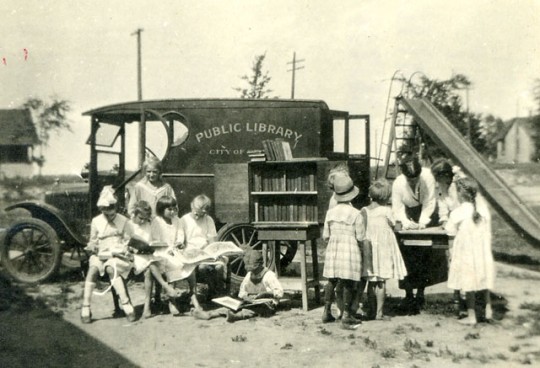
in front of the first saint paul public library bookmobile, 1917.
—
“i’m of a fearsome mind to throw my arms around
every living librarian who crosses my path,
on behalf of the souls they never knew they saved.”
– barbara kingsolver
—
photo credit: st.paul public library
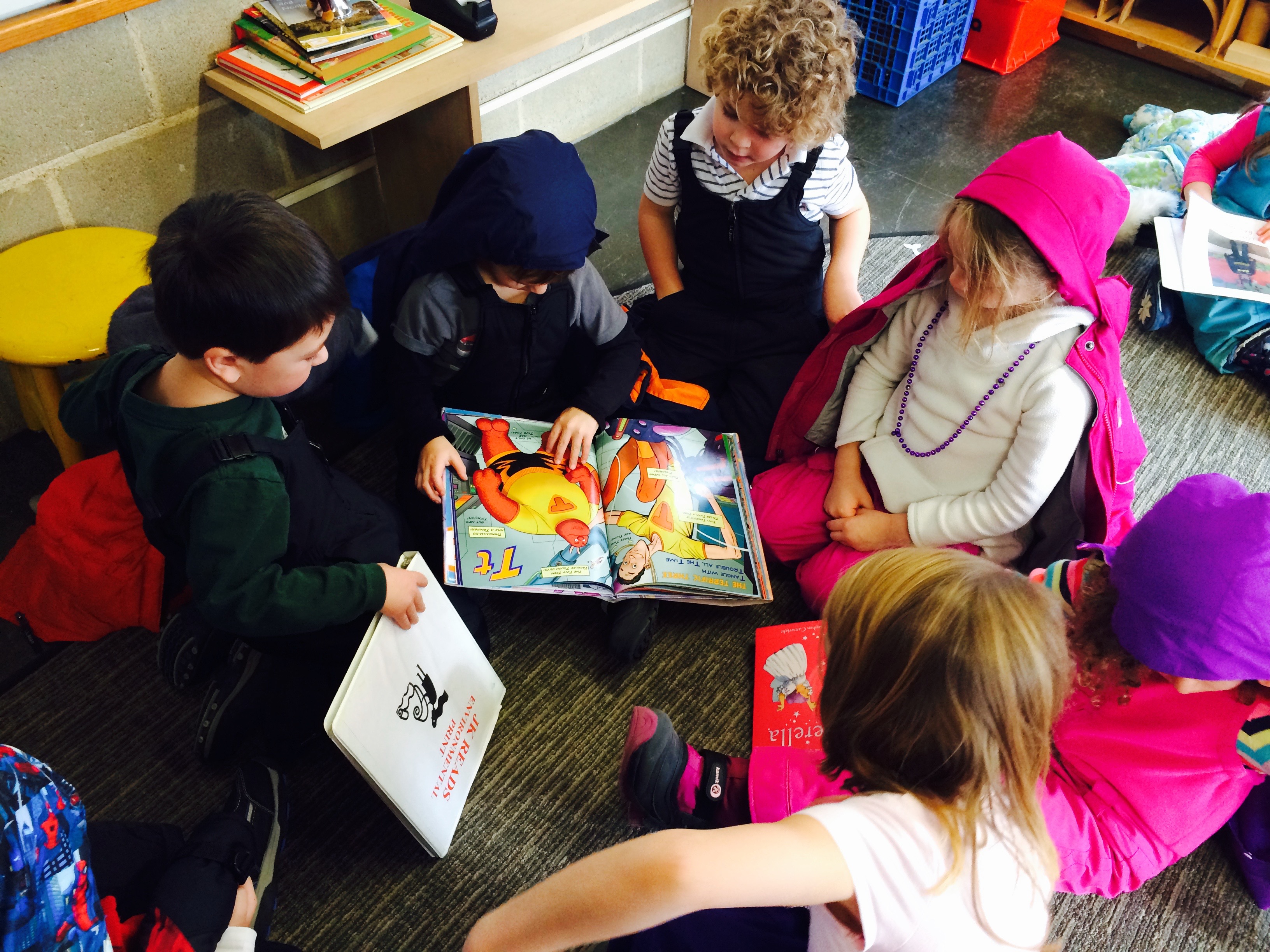
book club happens
while waiting to go outside
and discovers something.
letters.
—
there is more treasure in books
than in all the pirate’s loot on treasure island.
– walt disney
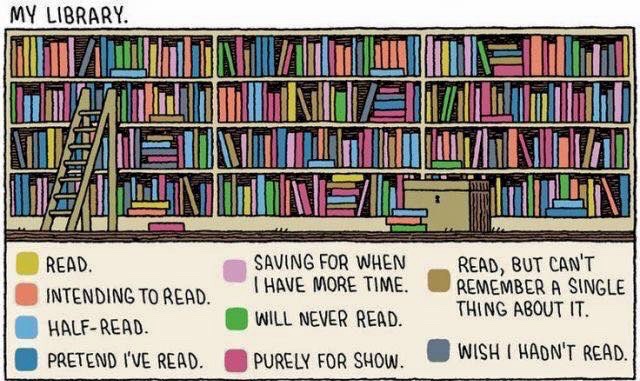
one way to organize.
—
image credit: reading rainbow
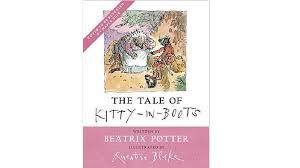
100 Years Later,
Beatrix Potter’s Tale Of A Fanciful Feline To Be Published
At long-lost Beatrix Potter book, The Tale of Kitty-in-Boots, is set to be released this fall, 150 years after the beloved author’s birth.
The tale about a sharply dressed feline has “all the hallmarks of Potter’s best works,” editor Jo Hanks, who stumbled upon the story, says in an interview with Penguin U.K., which will publish the book.
At the time Potter was writing Kitty-in-Boots in 1914, she told her publisher that the story was centered on “a well-behaved prime black Kitty cat, who leads rather a double life.”
Hanks says she “stumbled on an out-of-print collection of her writings” and saw that reference to the story in a letter from Potter to her publisher.
This led her to the publisher’s archive, where she says she found “three manuscripts, two handwritten in children’s school notebooks and one typeset and laid out in a dummy book; one rough colour sketch of Kitty-in-Boots and
a pencil rough of our favourite arch-villain, Mr Tod.”
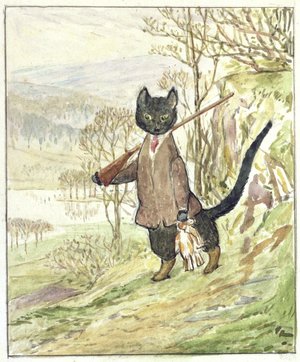 The original Kitty in Boots,
which Beatrix Potter illustrated herself.
The tale features a favorite Potter character — Peter Rabbit — “albeit older, slower and portlier,” Hanks says. Potter told her publisher in letters that the story went unfinished because of “interruptions” — including the start of World War I and her marriage.
And because Potter finished only one drawing for the book, it will be illustrated by Quentin Blake, who is best-known for his art in many of Roald Dahl’s books.
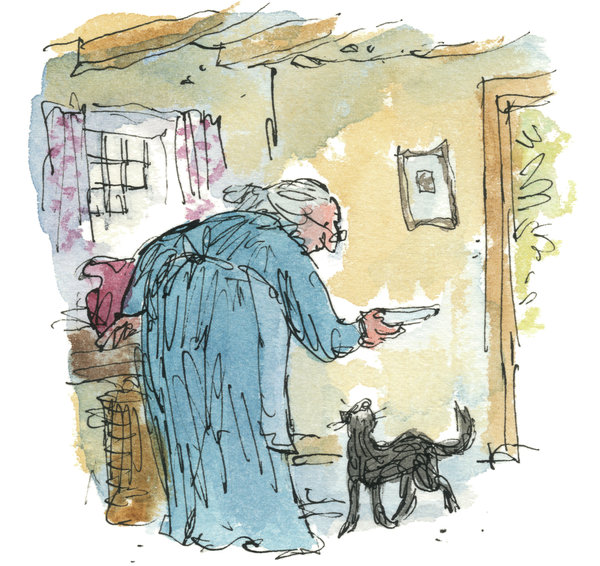
Quentin Blake’s Kitty in Boots.
“Quentin revels in rebellious characters and humorous stories with spiky edge to them; he’s brought anarchic energy to the character of Kitty and embellished her already endearingly flawed character with his trademark wit and charm,” Hanks says. The news about Blake’s illustration has delighted many Potter fans. Others are more skeptical about the pairing.
Here’s an excerpt from the story released by Penguin, with a cliffhanger ending:
“Once upon a time there was a serious, well-behaved young black cat.
“It belonged to a kind old lady who assured me that no other cat could compare with Kitty.“She lived in constant fear that Kitty might be stolen — ‘I hear there is a shocking fashion for black cat-skin muffs; wherever is Kitty gone to? Kitty! Kitty!’
“She called it ‘Kitty’, but Kitty called herself ‘Miss Catherine St. Quintin’
“Cheesebox called her ‘Q’, and Winkiepeeps called her ‘Squintums’. They were very common cats. The old lady would have been shocked had she known of the acquaintance.
“And she would have been painfully surprised had she ever seen Miss Kitty in a gentleman’s Norfolk jacket, and little fur-lined boots. “Now most cats love the moonlight and staying out at nights; it was curious how willingly Miss Kitty went to bed. And although the wash-house where she slept — locked in — was always very clean, upon some mornings Kitty was let out with a black chin. And on other mornings her tail seemed thicker, and she scratched.
“It puzzled me. It was a long time before I guessed there were in fact two black cats!”
You’ll have to wait until the book is published in September to find out what happens next.
—
credits: quentin blake, beatrix potter, penguin press, express newspapers, getty images, npr
 on the desk in roald dahl’s writing hut, right next to the chair where he sat to write many of his famous stories – including charlie and the chocolate factory – there is a collection of strange and wonderful items, some of which are particularly curious.
one of these is what appears to be a cannonball. it’s grey and fits into the palm of one hand. it looks like it would be quite heavy. it’s not a cannonball, though. it’s actually chocolate wrappers. hundreds and hundreds of silver foil wrappers that were originally used to keep a chocolate bar nice and fresh.
when roald was working for shell oil in london, before he set off on his adventures in africa and then on to the second world war, he often used to have a chocolate bar with his lunch. every time he had a chocolate bar he would add the wrapper to his growing collection. the first one he wrapped up into a little ball, and then every time he had another he would wrap it around the one from the day before, and so eventually the little ball of silver foil wrappers grew larger and heavier and took on the cannonball-like appearance it has today.
roald kept this collection of chocolate wrappers on the desk in his writing hut along with other things that inspired him, or reminded him of his earlier days. if you’re ever in the roald dahl museum and story centre in great missenden you can see it for yourself.
—
credits: roalddahl.com
 I didn't have my glasses on....