a little girl
who was once my student
and still a friend of mine
opened up a treasure chest
to show me
one piece of clothing after another
that she created all on her own
after teaching herself to sew
and I couldn’t be more proud.

when walking in a park near my daughter’s house
an illustrated storybook trail
with pages spread throughout the woods
placed there by the village and the local library
a perfect pairing.
Time is important at an airport, with thousands of people running back and forth trying to get their plane on time. This is why most airports are full of clocks everywhere, helping to guide harried travelers. Schiphol Airport in the Netherlands is no exception, but it offers a twist: a giant clock that appears as if a man is busy painting it real time, minute by minute.
Schiphol Clock
It appears as if a man is standing behind this giant airport clock, painting the hands in real time. The painter is actually a 12-hour-long recording, that gives a convincing illusion that a human is standing inside the translucent clock, busy at work as the hands go around. This creative timepiece is the latest work of Maarten Baas, a well-known Dutch artist and designer that has a series of similar live clock recordings.
The Schiphol Airport clock was created by Baas in 2016. The man inside the clock is wearing blue overalls and has a yellow rag in his pocket. This, together with his red bucket, is meant to be an homage to the famous Dutch artist Mondrian.
The clock can be seen in the airport’s International terminal, so it is only visible to people leaving the European Union via Amsterdam Airport Schiphol, located in the International terminal.
we say that time passes, time goes by, and time flows.
those are metaphors.
we also think of time as a medium in which we exist.
-james gleick
—
sources: atlas obscura, dutch design daily

the eight giant, colorful tops, designed by *héctor esrawe and ignacio cadena, are large enough for multiple people to sit or stand inside them, and visitors are welcome to take a spin. they were designed to facilitate play, celebrate culture, and bring people together to interact and connect. Los Trompos is an interactive piece that comes to life when people engage with it. the tops are based on the construction of the actual toy and reflect the work of mexican artisans, as well as mexican culture, art, and architecture.
—
“simply enjoy life and the great pleasures that come with it.”
-karolina ku
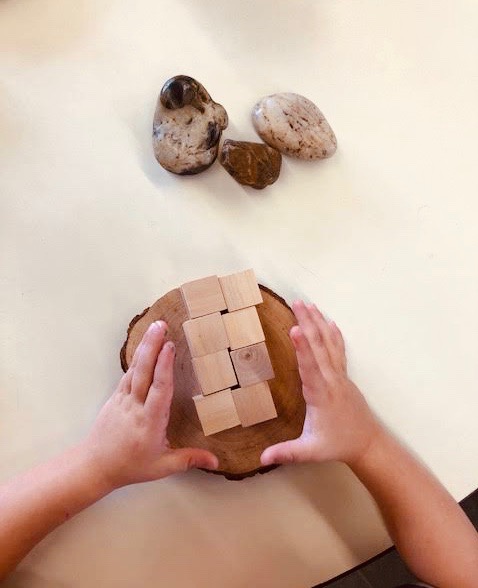
the theory of loose parts and the right to be creative.
(kinders live this every day)
—
“in any environment,
both the degree of inventiveness and creativity,
and the
possibility of discovery,
are directly proportional
to the number
and kind of
variables in it.”
-theory credit: Simon Nicholson – The Theory of Loose Parts, 1971

Inspired by the nature around her, artist Katie Holten recently developed the New York City Tree Alphabet. Each letter is represented by an illustration of a different type of tree found in NYC. The letter A, for example is depicted as an ash tree, and the letter O is illustrated as an oak.
Holten is one of the first creatives to become an NYC Parks artist-in-residence, where she was asked to explore “the intersection of art, urban ecology, sustainability, nature, and design.” Holten’s resulting NYC Trees font is now available as a free download to anyone who wants to write secret messages in tree code. Not only that, but the NYC Parks Department plans to actually plant some of the messages as real trees in parks and other public spaces.
“Being an artist-in-residence with Parks meant that I could create a ‘real’ tree alphabet. When I say real, I mean legitimate, sanctioned, approved by the city,” Holten explains. “Often, this is exactly what you don’t want with/for an artwork! But in this case, because I really feel the project is a public service—providing a tool that people can use to interact with public space in a whole new way—it needed to be truthful and practical. It had to be something we could actually plant and that the city supported.”
Holten is currently accepting message submissions via her website. From poems to love letters, you can test out how your words would look as trees using the “Write with Trees” function on her homepage. “Right now, we’re leaving it completely wide open, so we’ve no idea what messages we’ll be planting. I’m excited to see what people send us,” Holten writes. “People have been suggesting words like ‘Dream,’ ‘Hope,’ and ‘Peace.’ But we’re also receiving longer messages, love letters, poems, and short stories. We’re curious to see how we could translate a long text into a grove of planted trees. It’s an exciting challenge and we can make up the rules as we go along, so anything could happen.”
Do you have a message you’d like to translate into your own custom forest? Planting begins in April 2019 in New York City. Download the font for free and check out Holten’s website for more details on the project.

image credit: Katie Holten
King Arthur at Tintagel, Cornwall. On the cliff by his castle.
—
Sculptor Rubin Enyon creates unforgettable public artwork using a variety of mediums—from wood and stone to iron and bronze. His recent work, Gallos, was installed in April 2016, overlooking the Atlantic Ocean on the cliffs of Tintagel. The stately 8-foot-high bronze sculpture was not only inspired by the legend of King Arthur, but also Tintagel Castle’s history. Commissioned by English Heritage, the public sculpture is located in Tintagel, a village in Cornwall, known as the legendary site of King Arthur’s conception.
—
“all the great legends are templates for human behavior.
i would define a myth as a story that has survived.”
-john boorman
—
credits: rubin enyon- sculptor, selectcornwall.co.uk, british medieval history, english heritage