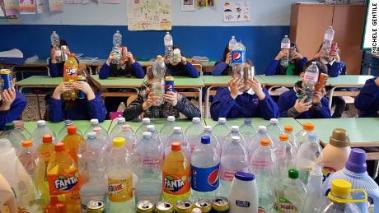
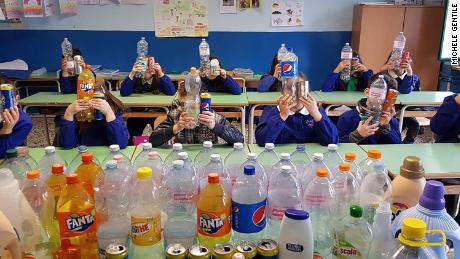
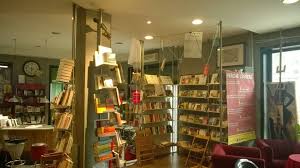
Children at San Rufo elementary school in Salerno, southern Italy, are swapping plastic for books. A bookseller/cafe owner in southern Italy is offering free books to schoolchildren who bring him one plastic bottle and one aluminum can to recycle. Michele Gentile, who founded the Ex Libris Cafe bookshop in Polla, a small town near Salerno, said he wants to encourage kids to read while doing something for the environment.
“My goal is to spread the passion and love for books among those people in Italy who do not usually read, while at the time helping the environment,” he said. “I hope the initiative becomes so viral that it affects the whole country. It will be revolutionary, not only for the planet but also for the education of children and their job prospects,” he said.
The books being donated for the initiative are the so-called “pending” or “suspended” books (“libri sospesi” in Italian), a concept introduced by Gentile a few years ago that earned him headlines in national media. The term derives from the “suspended coffee” Neapolitan tradition, born during World War II, of purchasing two coffees: one for yourself and the second one as an anonymous gift for the next customer in need who walks into the bar. Similarly, Ex Libris customers can buy one book and leave the second one “suspended” for whomever needs it.
The idea for the “plastic/metal for books” recycling initiative came to Gentile while he was looking at a huge pile of metallic waste left abandoned on a field. “It was worth at least 300-400 euros ($338-$451), enough to pay for a middle school kid’s book allowance for a year,” he said. “So, I talked to a local school, and they organized an aluminum collection. Results were extraordinary, about 2 quintals ($564) in two days.” With the money he got from the recycling center, Gentile bought books for a whole class. “So, I thought: Why not (give) away books to kids who bring me plastic bottles and cans?” he said.
His initiative, which involves individuals and schools, has already reached northern Italy, with children from Bordighera, in the Liguria region, sending him 23 bottles and 23 cans to recycle. “Yesterday alone, I donated 60 suspended books,” Gentile said. “Imagine if this becomes a small game: Every child in the world swaps a plastic bottle and a can for books. I know it’s just a dream, but why not do it?“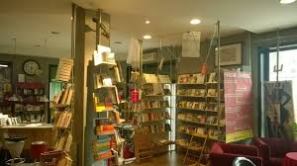
“it takes generosity to discover the whole through others.
If you realize you are only a violin,
you can open yourself up to the world by playing your role in the concert.”
-jacques yves cousteau
—
credits: cnn world news, gianluca mezzofiore





 I didn't have my glasses on....