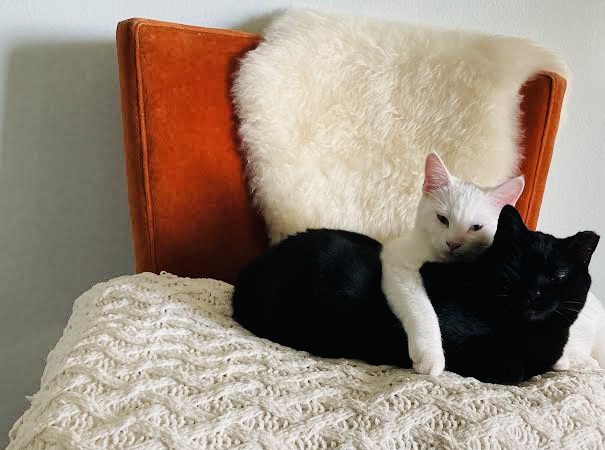
olive and yeti find their fit
—
“the best thing to hold onto in life is each other.”
-audrey hepburn
olive and yeti find their fit
—
“the best thing to hold onto in life is each other.”
-audrey hepburn
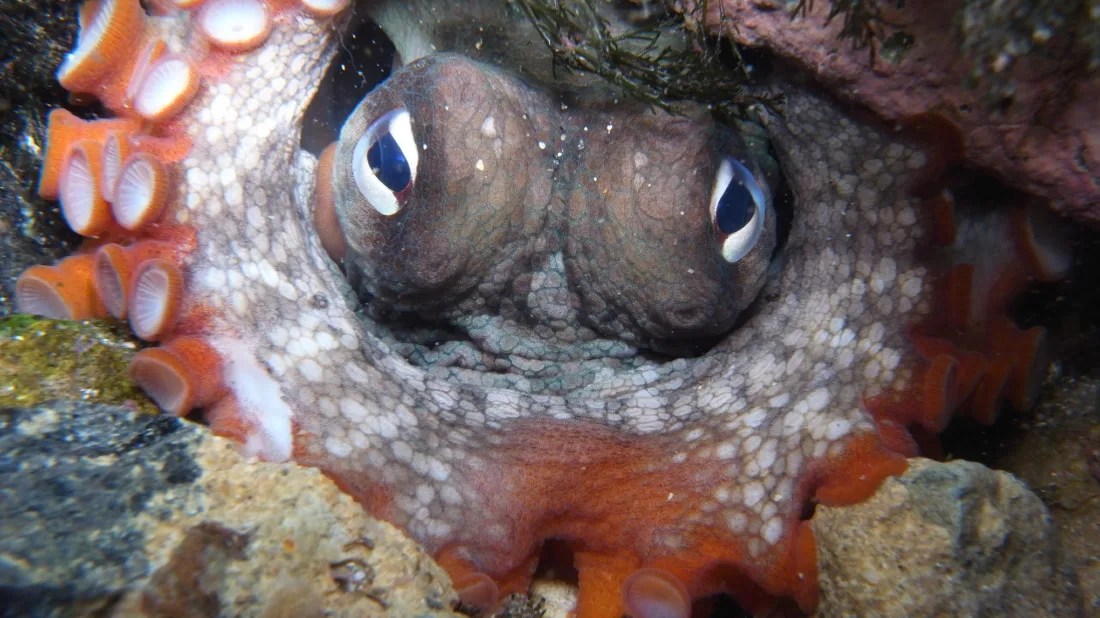 The octopus is one of nature’s smartest and most enigmatic creatures, seemingly able to engage in some of the more complex thought processes in nature while also taking advantage of its unique physical abilities. Recently, some angry cephalopods were discovered to be assaulting fish by striking them with an arm.
Their taste for violence doesn’t end there. A new study demonstrates that when an octopus wants to be left alone, it’s not above tossing the nearest object at the noggin of its target.
Researchers at the University of Sydney published their findings in the science journal bioRxiv, and it’s clear that octopuses have a low tolerance for unwelcome visitors. Observing them off the eastern coast of Australia, scientists witnessed octopuses hurling shells, algae, and other debris at other octopuses in an effort to warn them off.
Octopuses don’t “throw” objects the way a human might. Instead, they use their arms to position the object in front of their siphons, which can produce a jet stream of water that propels the material into their adversary.
This behavior has been observed before, but this new study shed some fresh light on their motivations. The footage obtained via GoPro cameras captured a number of female octopuses throwing shells at would-be male suitors, a kind of swiping left, using blunt force.
In these cases, the males were not always discouraged. One bachelor was hit 10 times but stuck around. Others attempted to dodge the projectiles. Octopuses can toss objects for other reasons. They may, for example, want to clean up their living space by removing clutter. In some cases, that unwanted clutter may also mean a pushy mate.
—
“you want trouble, you can get trouble”
s. rotslach
—
credits:
Photo- S. Rotslach/Getty Images, Mental Floss/J. Rossen, Science Alert/ M. Starr, University of Sydney/bioRxiv
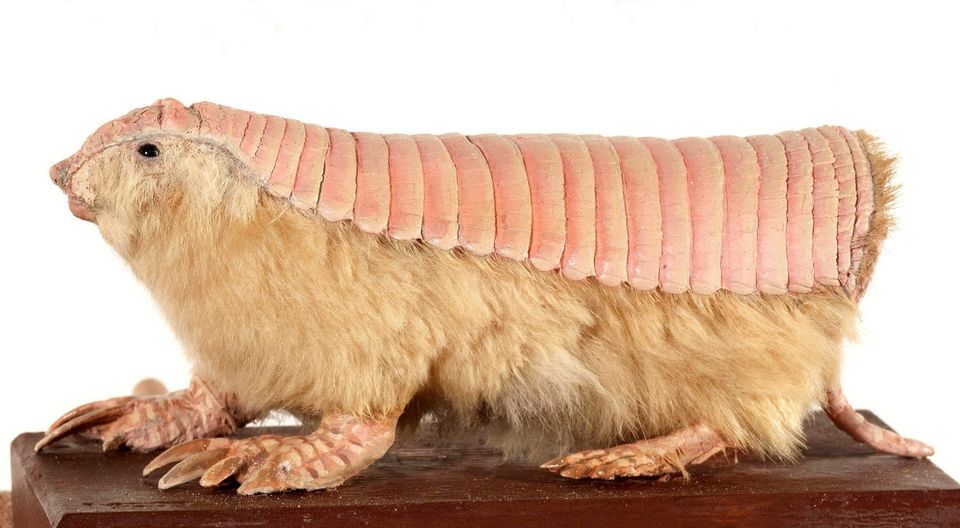
Today in animals you might not believe are real (but are!): the pink fairy armadillo. This species (Chlamyphorus truncatus) grows to just about 6 inches long, making them the smallest armadillos in the world.
They are found only in central Argentina, and because they’re nocturnal and spend a lot of time burrowing underground, the elusive creatures are difficult to study.
Like other armadillos, pink fairy armadillos have a shell (or carapace) but theirs is softer, thinner and more flexible. The shell’s color comes from blood vessels close to the surface.
source credit: Smithsonian National Museum of Natural History
—
“always be yourself unless you can be an armadillo,
then always be an armadillo.”
-author unknown
—
some animals are so unusual, it’s hard to believe they’re real.
what’s the most interesting/unusual animal you’ve ever encountered?
—

everything is growing and changing
all in their own time
each in their own way
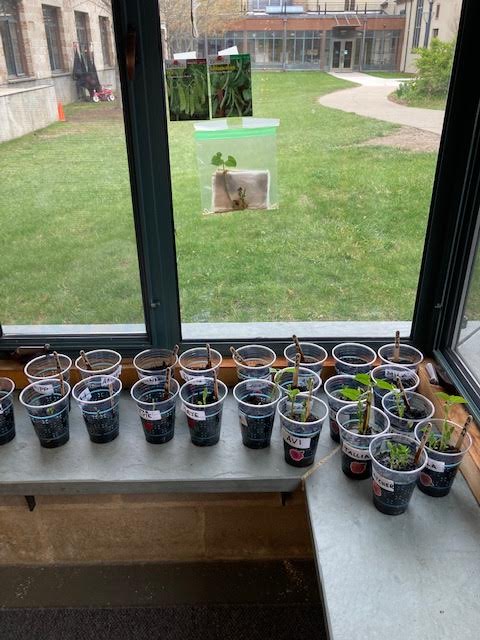
we watch and care for them

soon they will all be something new.
—
“and the day came when the risk to remain tight in a bud was more painful than the risk it took to blossom.”
― Anais Nin
today at the toledo zoo
so many beautiful animals
the birds – stunning
even
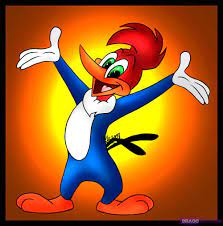
the very curious and friendly woodpecker
hanging on the screen following us around
staring and blinking
so cute and cheery
reaching over to touch it
quickly reminded me
how it got its name
when it pecked my finger
with the memorable touch of
a sewing machine needle/jack hammer
decided right there and then
to just admire each other from afar in the future.
—
“all bad jazz sounds like woody woodpecker.”
-leo kottke – musician
—
image credit: Woody Woodpecker – Walter Lantz Studio, Universal Studios

a group of penguins in the water is called a raft- on land, they become a waddle.
—
“all penguins are the same below the surface,
which I think is as perfect an analogy as we’re likely to get for the futility of racism.”
-Russell Brand
—
art credit: Wood print by Kaamran Hafeez, One Penguin in a Large. Group of Penguins

today at school
we looked up
way up
on top
of the carved art pole
covered in languages
all saying one thing
‘peace’
a hopeful sign
the kinder
could not stop watching
this beautiful bird
as it flew up to the tree
and off into the sky.
—
we may be losing the ability
to understand animals who are not pets or horses.
we have less contact with them.
we don’t (most of us) tend to know even cows or pigs,
let alone bears or wolverines or red tailed hawks.
*-marge piercy
*Marge Piercy (1936) is an American poet, novelist, and social activist. Her work includes Woman on the Edge of Time; He, She and It, which won the 1993 Arthur C. Clarke Award; and Gone to Soldiers, a New York Times Best Seller, a sweeping historical novel set during World War II. Piercy’s work is rooted in her Jewish heritage, social and political activism, and her feminist ideals. She influenced the Women’s Movement through both her writing and her unconventional life.

just because taking 4 minutes to watch this might make you smile all day. (sound up!)

National Park Service Notice –
READ: Please don’t run from bears or push your slower friends down in attempts of saving yourself.
As a follow-up to a previous post, if you come upon a stationary bear, move away slowly and sideways; this allows you to keep an eye on the bear and avoid tripping. Moving sideways is also non-threatening to bears. Do NOT run, but if the bear follows, stop and hold your ground. Like dogs, they will chase fleeing animals. Do NOT climb a tree. Both grizzlies and black bears can climb trees. Do NOT push down a slower friend (even if you think the friendship has run its course).
Stay calm and remember that most bears do not want to attack you; they usually just want to be left alone. Don’t we all? Identify yourself by making noise so the bear knows you are a human and not a prey animal. Help the bear recognize you as a human. We recommend using your voice. (Waving and showing off your opposable thumb means nothing to the bear) The bear may come closer or stand on its hind legs to get a better look or smell. A standing bear is usually curious, not threatening.
P.S. We apologize to any “friends” who were brought on a hike as the “bait” or were sacrificed to save the group. You will be missed.
#FindYourPark #RecreateResponsibly
https://www.nps.gov/subjects/bears/index.htm
—
“i’d rather write about polar bears than people”
-mary oliver
—
image credit: Bear resting on a log thinking bear things at Katmai National Park & Preserve, NPS/ J. Ehrlenbach

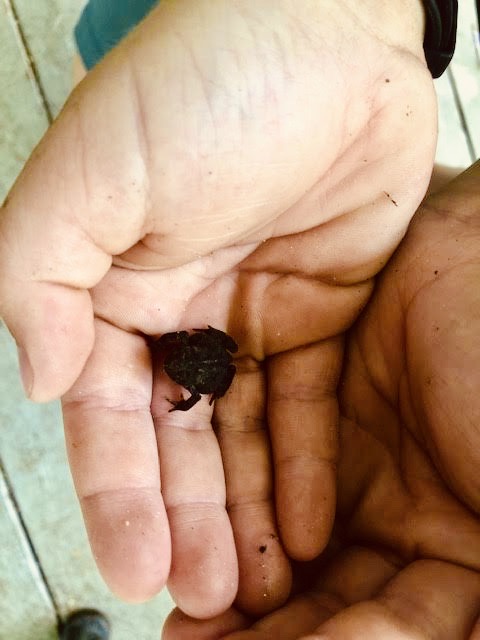
a tiny toad crossed paths with grandie f
i wonder which one was more excited to meet the other.
—
“the smaller the creature, the bolder its spirit.”
-suzy kassem, Rise Up and Salute the Sun
 I didn't have my glasses on....