not all minds that wander are lost.

Standard

after reading this research i now see why i am happy most of the time-

i am an idle mind-wanderer.

it’s my best sport. 

Research suggests that people with freely moving thoughts are happier.

“Sometimes you just want to let your mind go free,” says Julia Kam, a cognitive neuroscientist who directs the Internal Attention Lab at the University of Calgary. Kam became interested in her subject 15 years ago as an undergraduate struggling with her own distracted thoughts during lectures. “I came into the field wanting to find a cure,” she says. But the deeper she got into research, the more she came to appreciate the freedom of an unfocused mind. “When your thoughts are just jumping from one topic to the next without an overarching theme or goal, that can be very liberating,” she says.

Researchers have found that people spend up to 50 percent of their time mind-wandering. Some internal thinking can be detrimental, especially the churning, ruminative sort often associated with depression and anxiety. Try instead to cultivate what psychologists call freely moving thoughts. Such nimble thinking might start with a yearning to see your grandmother, then careen to that feeling you get when looking down at clouds from an airplane, and then suddenly you’re pondering how deep you’d have to bore into the earth below your feet before you hit magma. Research suggests that people who do more of that type of mind-wandering are happier.

Facilitate unconstrained thinking by engaging in an easy, repetitive activity like walking; avoid it during riskier undertakings like driving. You’ll find it harder to go free-ranging if you’re myopically worried about something in your personal life, like an illness or an argument with a spouse.

For a recent study, Kam hooked subjects up for an electroencephalogram and then had them do a mundane task on a keyboard while periodically asking them about their thoughts. She was able to see, for the first time, a distinct neural marker for freely moving thoughts, which caused an increase in alpha waves in the brain’s frontal cortex. This is the same region where scientists see alpha waves in people doing creative problem-solving. We live in a culture that values work and productivity over almost everything else, but remember, your mind is yours. Make space to think in idle ways unrelated to tasks. “It can replenish you,” Kam says.


“i was trying to daydream, but my mind kept wandering.”

-steven wright


—

credits: nytimes/sunday magazine, ‘how to let your mind wander’- malia wollan , university of calgary


no mo’ venmo.

Standard

vs.

coming up on the 4-month mark

of an ongoing battle with venmo

can’t even begin to tell the story in short form

 truly the perfect storm of events.

after talking, live chatting, and e-mailing

landon, santiago, elizabeth, miguel, ren, sacha, and abby

i won’t say which low-budget model above

most resembles me in the match

but i will say there is no doubt i am winning.

p.s.

i wonder if team venmo is posting a blog today

with our pictures

saying there is no doubt they are winning.

—

“i don’t like customer service because i don’t believe the customer should have to pay and help out too.”

-jarod kintz


this diamond has so many carats it’s almost a turnip.-richard burton

Standard

Turnip Schnapps

The modest root vegetable makes a potent liquor in Wildschönau, Austria.

If all the world’s vegetables gathered for a shindig, the humble turnip probably wouldn’t be the life of the party. But in Austria’s Wildschönau Valley, a shot of schnapps made from the root veggie could very well get one started. Local residents have been distilling a strong turnip liquor called Wildschönauer Krautinger as far back as the 1700s, when Habsburg empress Maria Theresa granted 51 area farmers the exclusive rights to produce it. Around 15 families still make it today. Wildschönau residents celebrate all things turnip during the Krautinger Week festival in October.

Turnips were traditionally a staple of the alpine diet since they can tolerate the challenging mountain growing conditions. Turnip sauerkraut provided nourishment throughout the winter, improved digestion, and the vegetable even earned a spot on some noble families’ coats of arms.

The schnapps is unique, with a distinct whiff of vegetables. “The smell takes some getting used to and you either love or hate the taste,” a tourist site promoting the region concedes. One blogger describes it as “a hit of pure sauerkraut, which [trails] off into something weird which reminded me of a pair of training shoes I once owned.” (Best review ever)

 —

 “I was raised almost entirely on turnips and potatoes,

but I think that the turnips had more to do with the effect than the potatoes.“

-Marlene Deitrich


—

credits: gastro obscura, wildschonau tourismus, photographer – r. newman

perfume and purse dirt.

Standard

yes, i found this old piece of gum

on the bottom of my purse

half-opened with glittery stuff and crumbs of unknown origin stuck to it

what might you find in the bottom of your/your mother’s purse?


—

“when your mom gives you a pre-ripped half piece of doublemint gum

and it tastes like perfume and purse dirt. “

– author unknown

i didn’t go to the waterpark because it was raining, and i didn’t want to get wet. -jarod kintz

Standard

perfect day for a waterpark visit

 full of

action, sun, squealing

 and lots and lots of water

i’m at my best in the lazy river area.


—

“as a group, we’ve been banned from two water parks, one bar, and a dog-grooming salon.”

-j.a. rock – author

oldies.

Standard

happy i’m still around and sweatin’ with the rest of the michigan oldies – one more special day to celebrate

Header 2021

FOR IMMEDIATE RELEASE

August 20, 2021

Governor Whitmer proclaims August 21 as Older Michigander Day

LANSING, Mich. – Gov. Gretchen Whitmer, in partnership with the Michigan Department of Health and Human Services (MDHHS), is celebrating the state’s more than 2.4 million adults aged 60 years and older by proclaiming Aug. 21 as Older Michigander Day.


“the great thing about getting older is that you don’t lose all the other ages you’ve been.”

-Madeleine L’Engle

sing for your dinner.

Standard

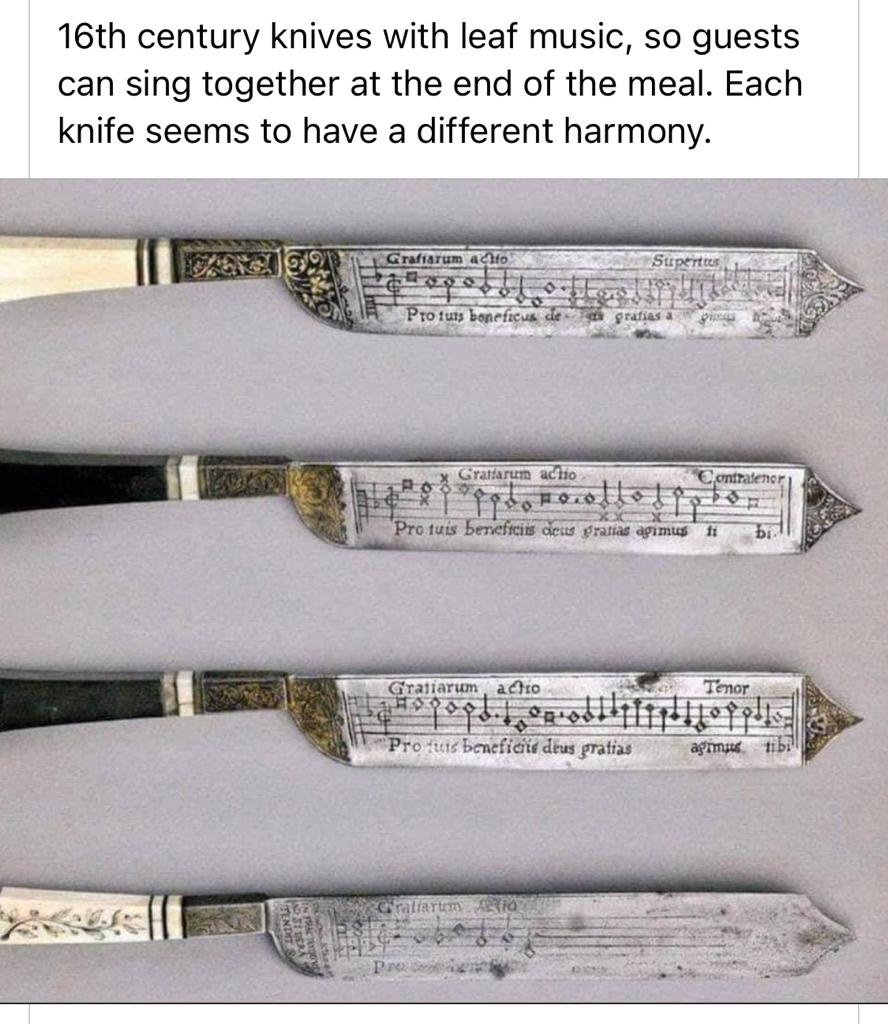
i found this picture of these knives and really wanted to know more. their story is fascinating.

—

Knives with musical notes on the blades are known as notation knives. A notation is the written version of a physical process, such as the sound of music. Once it is written down it can be preserved and recreated.  Sung at four different levels.They are the four parts Superius (Soprano) Countratenor (Alto), Tenor, and Bassus (Bass) to be sung simultaneously as in a hymn.

These knives are etched with notations expressing gratitude for a meal. On one side of the blade the inscription translates as, ‘The blessing of the table. May the three-in-one bless that which we are about to eat’, to be sung before the meal is taken. On the other side the notation gives thanks after the meal: ‘The saying of grace. We give thanks to you God for your generosity’. The point of the knife allows meat or bread to be skewered and offered to a fellow diner. Notation knives are extremely rare.

The interesting history of notation knives is explained here on YouTube and the music has been gloriously performed toward the end of the video. It’s only 5 minutes long . Well worth the time! https://youtu.be/-mai-7WUbBo


“those who wish to sing, always find a song.”

-swedish proverb


—

credits: Victoria and Albert Museum, AHRC, Flora Dennis, University of Sussex

crap.

Standard

classy crap boutique – keepin’ the c in classy-


—

“as long as people will accept crap, it will be financially profitable to dispense it.”

-dick cavett

all the loveliness.

Standard
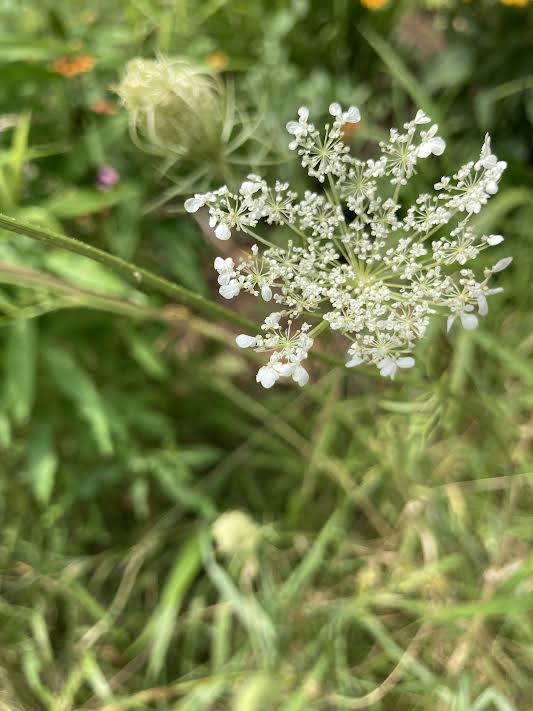
queen anne’s lace in august
—
Passing The Unworked Field
Queen Anne’s lace
is hardly prized but
neither is it idle,
look how it
stands fiercely
on its thin stem,
how it
nurtures its white budlets
with the
gift of the sun,
how it
makes for this world
all the
loveliness it can.
-Mary Oliver

smell of happiness.

Standard
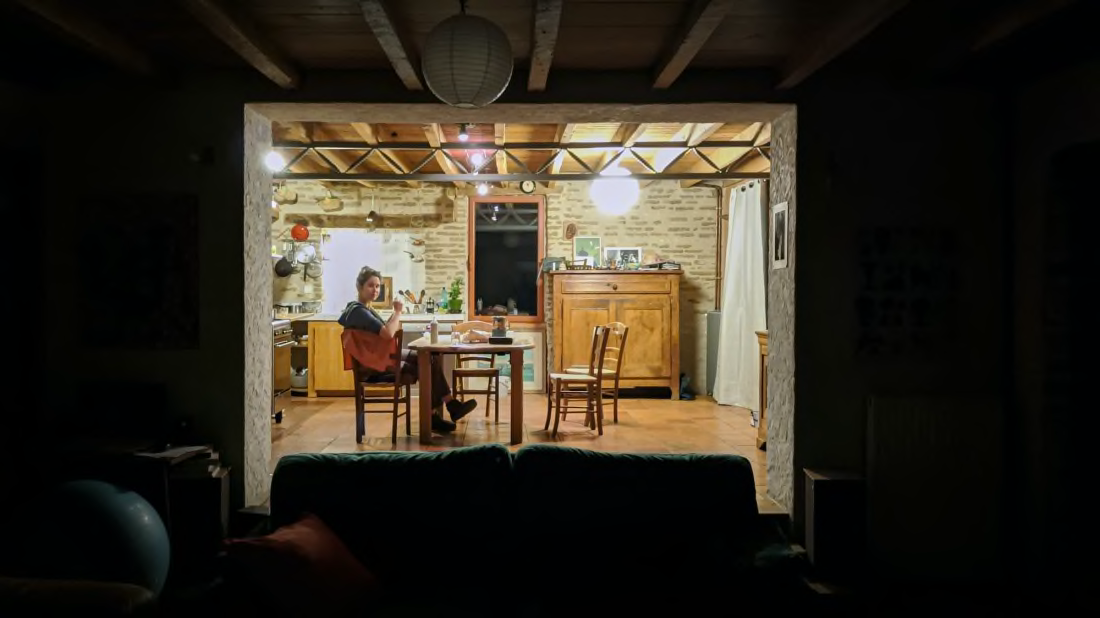
Your house smells. It's not your fault.
Your house smells. Don’t feel bad—it’s not just you! Your neighbor’s house smells, as does the White House. Even Martha Stewart’s abode has a distinctive odor. But not one of you could pick your own home’s aroma out of a scent lineup.

We adapt to smells very quickly. Within the space of just a few breaths, we can lose our ability to detect new odors. It’s called olfactory adaptation, and it’s the same reason you can’t smell your own breath, your body odor, or even your perfume after a few minutes. This, cognitive psychologist Pamela Dalton told New York Magazine, may be a good thing.

Every object in our environment gives off scented molecules. When you inhale, the molecules pass through your nostrils and stick to a wall of mucus on the back of your throat. That mucus is home to receptor cells that tell your brain what it is you’ve just sniffed. Our brains watch out for danger. Any change in our surroundings could represent a threat, so the brain focuses on new sights, sounds, feelings—and smells. After a few sniffs, you should know what needs to be dealt with and what’s okay to ignore. Fresh cut flowers? Nice, but not a problem. The smell of burning hair? Maybe to check that out.

Are you worried that your house reeks and nobody’s telling you? You may be able to find out by employing a few tricks of the perfume trade. Since familiarity is the key, you can give your nose a fresh start by leaving the house for a few hours. When you return, you should be able to get a good idea of what everyone else smells.

If that doesn’t work, try jumping around the room for a few minutes. The increased blood flow can briefly improve your sense of smell. Perfumers actually run up and down the stairs between sniffs, Dalton says. (The downside of vigorous exercise is that you may become a little fragrant yourself.

In the end, how the house smells may be less important than how we feel about it; there’s nothing quite like the smell of happiness.

—

“my theory on housework is,

if the item doesn’t multiply, smell, catch fire, or block the refrigerator door, let it be.

no one else cares. why should you?

-erma bombeck


—

story credits: mental floss – kate horowitz, new york magazine

image credit: tim oun